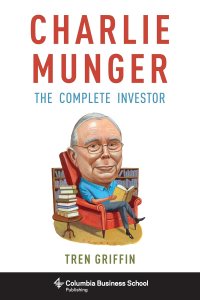
Charlie Munger: The Complete Investor by Tren Griffin
Charlie Munger (1924-2023) was vice chairman of Berkshire Hathaway for 46 years, working closely with Warren Buffett. This book is about their approach to investing, sprinkled with quotes from Munger, Buffett, and others.
From Networking to Boundary Spanning: How You Can Get Results Inside Large Organizations by Kitty Wooley
At its essence, this is advice to early-career employees from a retired U.S. federal government employee who rose through the ranks by taking initiative, making connections beyond her workgroup, and establishing herself as a go-to person to get things done. On another level, this is a call-to-action to shake up the organizational culture of large bureaucracies to make them more effective—and more fulfilling to work in.
Bottom Line Tales: 30 Lesser-known Ways to Build Sales, Profits, and Cash Flow by Alastair Thomson
This book reads like practical advice from a mentor. Alastair Thomson is a board-level executive with experience as a CEO and CFO in a variety of industries. In 30 chapters, he shares his wisdom about such topics as fixing operational bottlenecks, improving customer service, and minimizing bureaucracy. He shares a story of a company that grew revenues rapidly by making unprofitable deals. In a counter example, another company turned down profitable business below an arbitrary minimum order. He observes that companies claiming to be data-driven often make decisions without understanding what the numbers mean. He also shares his views on AI and semi-skimmed milk.
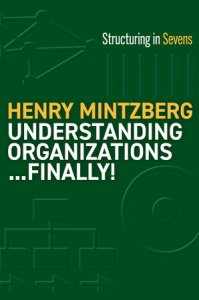
Understanding Organizations Finally! Structuring in Sevens by Henry Mintzberg
The four forms of organization are Personal (autocracy), Programmed (bureaucracy), Professional (meritocracy), and Project (adhocracy). Respectively, the coordinating mechanism of each form is direct supervision, standardization of work, standardization of skills, and mutual adjustment.
That last term should be defined before going further, as Mintzberg uses it throughout the book. “Coordination and control are two different concepts. Mutual adjustment is coordination without control… Currently, the literature of management gives considerable attention to teams, task forces, and networks, all manifestations of mutual adjustment.”
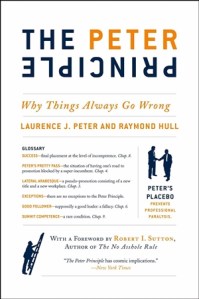
The Peter Principle: Why Things Always Go Wrong by Laurence J. Peter (1919-1990) and Raymond Hull (1919-1985)
For anyone who is frustrated with the dysfunction of a bureaucracy, this satirical study of hierarchiology—the social science of hierarchies—will shed some light. The Peter Principle states, “In a hierarchy, everyone tends to rise to his level of incompetence.”
Orbiting the Giant Hairball: A Corporate Fool’s Guide to Surviving with Grace by Gordon MacKenzie
This book is about maintaining creativity within bureaucratic environments. Gordon MacKenzie worked as an artist at Hallmark Cards for 30 years, culminating in a role titled Corporate Paradox.
Authentic Leadership: Rediscovering the Secrets to Creating Lasting Value by Bill George
Former Medtronic chairman and CEO Bill George wrote this book following a series of corporate scandals, including Enron, Sunbeam, Tyco, and Worldcom—just to name a few. These companies imploded because management was fixated on maximizing short-term shareholder value.
To paraphrase my favorite line in the book: you are running a business, not a stock. That said, the compound annual growth rate of Medtronic split-adjusted stock price was 28.5% during George’s 12-year tenure, according to my calculations. Not too shabby!
The first part of the book deals with the character, values, and sense of purpose required to inspire employees. George also shares his wisdom and personal experiences regarding customers, quality, market share, growth, innovation, acquisitions, FDA approval delays, Wall Street analysts, and corporate governance.