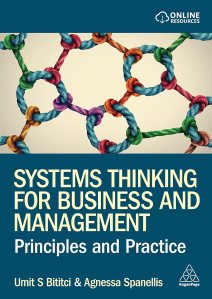
Systems Thinking for Business and Management


Systems Thinking for Business and Management
by Umit S. Bititci and Agnessa Spanellis

Organizations, markets, and economies are systems, analogous to ecosystems. This clearly-written, 278-page textbook written by professors from Edinburgh Business School and the University of Edinburgh introduces key concepts in systems thinking, including methods for modeling them and analyzing their behavior.

It is said that the purpose of higher education is to teach students to think. In this spirit, I believe future decisionmakers and policymakers would be well served by a course in systems thinking. I think every business school should include this subject in its curriculum.

“To understand the real value of systems thinking, we need to recognize that nothing in this world exists in isolation and that everything is connected to something else. Everything is affected by something and potentially affects something else. With systems thinking, one can begin to understand, explain, and predict why complex systems such as organizations, people, and societies behave the way they do.”

Continue reading “Systems Thinking for Business and Management”
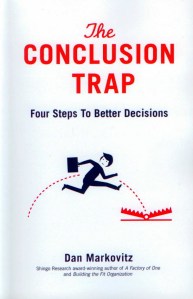
The Conclusion Trap: Four Steps to Better Decisions


The Conclusion Trap: Four Steps to Better Decisions
by Dan Markovitz

As a management consultant, Dan Markovitz has seen too many executives waste money on “Ready, Fire, Aim” decisions which yield no benefit—and sometimes even make things worse. “Frankly, I’m tired… of seeing leaders jump to conclusions and taking action without really understanding their problem.” This concise 67-page book resonates with me and I think it applies not only to business, but also more broadly to political policy on many of society’s complex issues, such as education and healthcare.

Continue reading “The Conclusion Trap: Four Steps to Better Decisions”

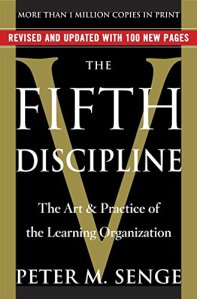
The Fifth Discipline


The Fifth Discipline: The Art and Practice of the Learning Organization
by Peter M. Senge

Senge writes, “I believe that, the prevailing system of management is, at its core, dedicated to mediocrity. It forces people to work harder and harder to compensate for failing to tap the spirit and collective intelligence that characterizes working together at their best.”

The subtitle is about the learning organization, but the book is also very much about systems thinking. 

Continue reading “The Fifth Discipline”

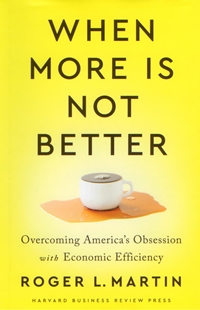
When More Is Not Better: Overcoming America’s Obsession with Economic Efficiency


When More Is Not Better: Overcoming America’s Obsession with Economic Efficiency
by Roger L. Martin

Roger Martin, dean of the Rotman School of Management at the University of Toronto from 1998 to 2013, writes about a fragile imbalance in the U.S. economy and the erosion of the middle class. Major themes include efficiency vs. resilience, reductionist thinking vs. complex adaptive systems, and gaming the system. He cites examples of companies where an obsession with efficiency was catastrophic, and conversely, where slack is the secret sauce. He offers policy solutions in such areas as antitrust, taxation, stockholder voting rights, and education.

Continue reading “When More Is Not Better: Overcoming America’s Obsession with Economic Efficiency”

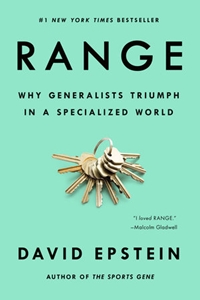
Range: Why Generalists Triumph in a Specialized World


Range: Why Generalists Triumph in a Specialized World
by David Epstein

“The response, in every field, to a ballooning library of human knowledge and an interconnected world has been to exalt increasingly narrow focus… Both training and professional incentives are aligning to accelerate specialization, creating intellectual archipelagos.”

In Range, David Epstein examines the advantages of having a range of experiences, a broader perspective, an interdisciplinary approach, and the value of flexible thinking and reasoning in a world full complexity and uncertainty where precise, deterministic solutions are unknowable.

Continue reading “Range: Why Generalists Triumph in a Specialized World”

2021 Castlin Manifesto: Strategy in Polemy


2021 Castlin Manifesto: Strategy in Polemy
by JP Castlin

JP Castlin is a strategic thinker and consultant based in Sweden. Major themes in his Manifesto are complexity and emergent strategy. In the chapter on marketing, he is not shy about challenging prominent figures. The paper is 71 pages including an impressive 9-page bibliography with academic papers, articles, and books cited throughout the text.

Continue reading “2021 Castlin Manifesto: Strategy in Polemy”

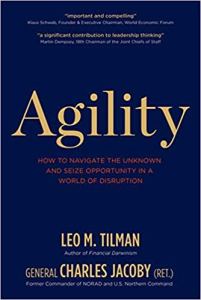
Agility: How to Navigate the Unknown and Seize Opportunity in a World of Disruption


Agility: How to Navigate the Unknown and Seize Opportunity in a World of Disruption
by Leo M. Tilman and Gen. Charles Jacoby (Ret.)

“The need for agility in business, government and warfare arises precisely from the uncertainty and complexity of the competitive environment.”

I imagine both co-authors of Agility have some battle scars—Tilman from Bear Stearns during the 2008 financial industry crisis and Jacoby from his career in the U.S. Army where he achieved the rank of 4-star general. Kidding aside, this book goes beyond military metaphors and presents a fusion of military and business thinking about risk intelligence and uncertainty as well as a leadership approach that emphasizes truth (as opposed to assumptions), trust, clear communication, and executional dexterity throughout the organization.

Complex adaptive systems “are constantly changing and evolving. They lack centralized control. They are inhabited by a multitude of stakeholders driven by distinct objectives, risk tolerances and modes of operation. These players interact in dynamic tension with one another, alternating between the urge to recoil from and engage in risk-taking and aggression. Their actions and adaptations lead to entirely unpredictable patterns and outcomes.”

Continue reading “Agility: How to Navigate the Unknown and Seize Opportunity in a World of Disruption”

Rethinking Risk Management: Critically Examining Old Ideas and New Concepts


Rethinking Risk Management: Critically Examining Old Ideas and New Concepts
by Rick Nason

Rick Nason challenges the status quo of risk management which mindlessly follows third-party frameworks and does too little independent thinking. He argues that risk management acts as “The Department of No” while ignoring upside risk. He envisions risk management as a strategic player in value creation rather than a cost center.

Continue reading “Rethinking Risk Management: Critically Examining Old Ideas and New Concepts”