Drawn to Life: 20 Golden Years of Disney Master Classes


Drawn to Life: 20 Golden Years of Disney Master Classes
by Walt Stanchfield (1919-2000). Edited by Don Hahn.

Walt Stanchfield began his animation career in 1937. In the 1980s and 90s he taught figure drawing classes for animators at Disney on Tuesday and Wednesday evenings. Disney producer Don Hahn compiled Stanchfield’s lecture notes and handouts into two volumes. The highlights below from Volume One capture some recurring themes.

The book includes drawings from Stanchfield and his students. This review includes more recent drawings by Brian Kennon, a former Disney artist who attended Stanchfield’s classes in the 1990s.

Continue reading “Drawn to Life: 20 Golden Years of Disney Master Classes”
More Human


More Human: How the Power of AI Can Transform the Way You Lead
by Rasmus Hougaard and Jacqueline Carter

More human means leveraging AI to unlock the best of our humanity and, simultaneously, to help us overcome some of our limitations. This is the art of the toggle, where we skillfully navigate getting the best of both human capabilities and AI. In this way, we can develop ourselves as better human leaders and thereby create better and more-human workplaces.”

The authors quote Tim Cook, CEO of Apple: “I’m not worried about artificial intelligence giving computers the ability to think like humans. I’m more concerned about people thinking like computers, without values or compassion, without concern for consequence.”

Continue reading “More Human”

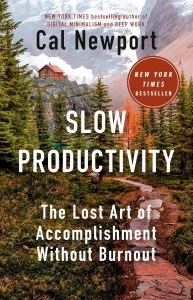
Slow Productivity: The Lost Art of Accomplishment Without Burnout


Slow Productivity: The Lost Art of Accomplishment Without Burnout
by Cal Newport

Slow Productivity is “a philosophy for organizing knowledge work efforts in a sustainable and meaningful manner, based on the following three principles: 1. Do fewer things; 2. Work at a natural pace; 3. Obsess over quality.”

Newport defines knowledge work as “the economic activity in which knowledge is transformed into an artifact with market value through the application of cognitive effort.”

“Concrete productivity metrics of the type that shaped the industrial sector will never properly fit the more amorphous knowledge work setting… In knowledge work… individuals are often wrangling complicated and constantly shifting workloads… In this setting, there’s no clear, single output to track.”

Continue reading “Slow Productivity: The Lost Art of Accomplishment Without Burnout”

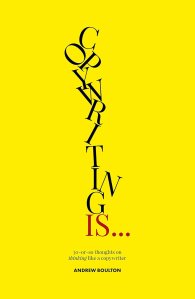
Copywriting Is…


Copywriting Is… 30-or-So Thoughts on Thinking Like a Copywriter
by Andrew Boulton  

Andrew Boulton is an advertising copywriter, lecturer, and columnist from the U.K. He is clearly a man of letters, but apparently not a numbers guy: this book has neither chapter numbers nor page numbers. I counted 36 chapters and 220 pages in which Boulton reflects on the creative practice of copywriting. Here are some highlights.

“We are in the business of purposeful attention—getting noticed, of course, but then doing something meaningful with that attention…The very nature of the job is to be, not the loudest voice, but the most compelling—to say something conventional and familiar in a way that feels extraordinary and unavoidable.”

Continue reading “Copywriting Is…”

Decisionscape: How Thinking Like an Artist Can Improve Our Decision-Making


Decisionscape: How Thinking Like an Artist Can Improve Our Decision-Making
by Elspeth Kirkman

“Knowingly or not, we often draw on the logic of pictorial space as a metaphor for our decisions. We use phrases like getting things in perspective or blowing them out of proportion… And we implore one another to zoom out or see the big picture.”

Elspeth Kirkman is a behavioral scientist who uses the analogy of art making to explain the psychology of decision making. “I call this mental representation the decisionscape… The central idea of this book is that we could improve our decisions, whether personal or professional, by constructing and analyzing it deliberately, just as an artist approaches the canvas.”

Continue reading “Decisionscape: How Thinking Like an Artist Can Improve Our Decision-Making”

Creativity: A Short and Cheerful Guide


Creativity: A Short and Cheerful Guide
by John Cleese

The central theme of this short book is tapping into your subconscious thoughts for ideas which you can then develop consciously and analytically. Cleese writes, “I began to realize that my unconscious was working on stuff all the time, without my being consciously aware of it.”

Continue reading “Creativity: A Short and Cheerful Guide”

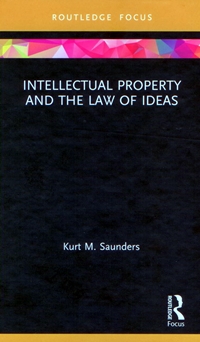
Intellectual Property and the Law of Ideas


Intellectual Property and the Law of Ideas
by Kurt M. Saunders, J.D., LL.M. 

“Valuable ideas take many directions—ideas for new or improved products, marketing strategies, advertising slogans, manufacturing processes, television show formats and movie plots, to name a few.”

“The law of ideas is the area of law involving employees, customers, inventors, and authors, who submit ideas capable of being reduced to practical application to business. It is a somewhat amorphous amalgam of contract law, property law, and tort law precedents that has been stitched together by courts over the years.”

Now there’s a book which pulls it all together.

Continue reading “Intellectual Property and the Law of Ideas”

Go Luck Yourself: 40 Ways to Stack the Odds in Your Brand’s Favour


Go Luck Yourself: 40 Ways to Stack the Odds in Your Brand’s Favour
by Andy Nairn

“After almost 30 years in advertising, I’ve often been struck by the pivotal role that chance plays… Luck remains a dirty secret because it’s seen to undermine the virtues of hard work, talent, and intelligence that are at the heart of any successful business culture… I believe that luck exists—and also that you can improve it.”

Andy Nairn is co-founder of Lucky Generals, a creative agency in the UK whose clients include Yorkshire Tea and the Co-op. His book consists of 40 bite-sized chapters divided into to four sections:

Continue reading “Go Luck Yourself: 40 Ways to Stack the Odds in Your Brand’s Favour”