The Shaping of an Effective Leader


The Shaping of an Effective Leader: Eight Formative Principles of Leadership
by Gayle D. Beebe

Westmont College president Gayle Beebe presents his eight principles of effective leadership and weaves in the wisdom of Peter Drucker, under whom he studied. The eight principles are character, competence, chemistry, culture, compatibility, convictions, connections, and commitment.

“Character is the foundation of all leadership responsibilities for all our life.” However, “without threshold competencies, even the most well-meaning individual can do real harm.”

Continue reading “The Shaping of an Effective Leader”
The Deviant’s Advantage


The Deviant’s Advantage: How to Use Fringe Ideas to Create Mass Markets
by Watts Wacker and Ryan Mathews

“Deviance is the source of all true innovation, growth, and indeed our collective survival. Deviance is defined by time, place, and circumstances.”

“Without deviance there would be no art, no scientific breakthroughs, no technological advances… Physical evolution is perhaps the perfect example of deviance in action. Without mutation—essentially deviance from an established DNA pattern—nature would remain static.”

“Don’t let the words deviant and deviance scare you. They’re being used in their purest definition—something or someone operating in a defined measure away from the norm.”

Continue reading “The Deviant’s Advantage”

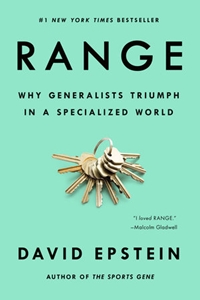
Range: Why Generalists Triumph in a Specialized World


Range: Why Generalists Triumph in a Specialized World
by David Epstein

“The response, in every field, to a ballooning library of human knowledge and an interconnected world has been to exalt increasingly narrow focus… Both training and professional incentives are aligning to accelerate specialization, creating intellectual archipelagos.”

In Range, David Epstein examines the advantages of having a range of experiences, a broader perspective, an interdisciplinary approach, and the value of flexible thinking and reasoning in a world full complexity and uncertainty where precise, deterministic solutions are unknowable.

Continue reading “Range: Why Generalists Triumph in a Specialized World”

101 Things I Learned in Architecture School


101 Things I Learned in Architecture School
by Matthew Frederick

Matthew Frederick presents 101 concepts in his “primer of architectural literacy.” Here is a sampling of his insights.

“Our experience of an architectural space is strongly influenced by how we arrive in it. A tall, bright space will feel taller and brighter if counterpointed by a low-ceilinged, softly lit space. A monumental or sacred space will feel more significant when placed at the end of a sequence of lesser spaces. A room with south-facing windows will be more strongly experienced after one passes through a series or north-facing spaces.”

Continue reading “101 Things I Learned in Architecture School”

The Lost Art of General Management

the-lost-art-of-general-mgmt

The Lost Art of General Management

by Rob Waite

In The Lost Art of General Management, Rob Waite shares practical insights from his career as a hands-on general manager for various building materials manufacturers in the U.S., Canada, Latin America, and Europe.  Like a good executive communicator, he gets straight to the point.

Waite contends today’s managers have become functionally myopic. A general manager needs to take a broader view, while understanding how the company makes its money and how its customers make money.

Continue reading “The Lost Art of General Management”