Humans are Underrated: What High Achievers Know that Brilliant Machines Never Will


Humans are Underrated: What High Achievers Know that Brilliant Machines Never Will
by Geoff Colvin

“The number of people who wrongly believed they could never be replaced by a computer keeps growing.” So what are the skills in which humans can maintain a competitive advantage over machines?

“Skills of interaction are becoming the key to success… Now, as technology drives forward more powerfully every year, the transition to the newly valuable skills of empathizing, collaborating, creating, leading, and building relationships is happening faster than corporations, governments, education systems, or most human psyches can keep up with.” 

Continue reading “Humans are Underrated: What High Achievers Know that Brilliant Machines Never Will”
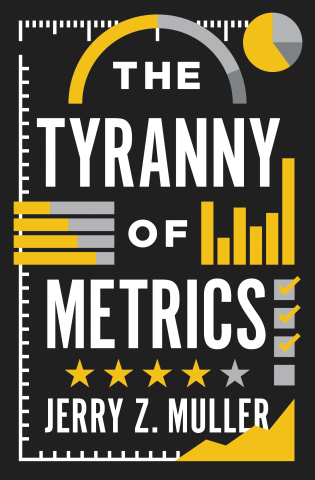
The Tyranny of Metrics


The Tyranny of Metrics
by Jerry Z. Muller

“This book argues that while they are a potentially valuable tool, the virtues of accountability metrics have been oversold, and their costs are often underappreciated.” There are chapters on the dysfunction of “metric fixation” in colleges and universities; schools; medicine; policing; the military; business; and philanthropy. Problems include gaming the system, costs exceeding benefits, and diverting effort from the core mission. A major theme is metrics as a substitute for competent judgment. 

Continue reading “The Tyranny of Metrics”

HBR Guide to Data Analytics Basics for Managers


HBR Guide to Data Analytics Basics for Managers

The objective of this book is to help managers make better data-driven decisions by working with data analysts and data scientists. The guide is a compendium adapted from 23 previously published Harvard Business Review and hbr.org articles.

“Framing a problem… is the most important stage of the analytical process for a consumer of big data. It’s where your business experience and intuition matter most. After all, a hypothesis is simply a hunch about how the world works. The difference with analytical thinking, of course, is that you use rigorous methods to test the hypothesis.”

Continue reading “HBR Guide to Data Analytics Basics for Managers”

Slack: Getting Past Burnout, Busywork, and the Myth of Total Efficiency


Slack: Getting Past Burnout, Busywork, and the Myth of Total Efficiency
by Tom DeMarco

Slack is an outstanding management book full of wisdom about corporate culture, change, failure, learning, quality, risk management, productivity, and managing people.

“You can’t grow if you can’t change at all.” Slack is “the lubricant of change… Slack represents operational capacity sacrificed in the interests of long-term health… Learning to think of it that way (instead of as waste) is what distinguishes organizations that are ‘in business’ from those that are merely busy.”

Continue reading “Slack: Getting Past Burnout, Busywork, and the Myth of Total Efficiency”

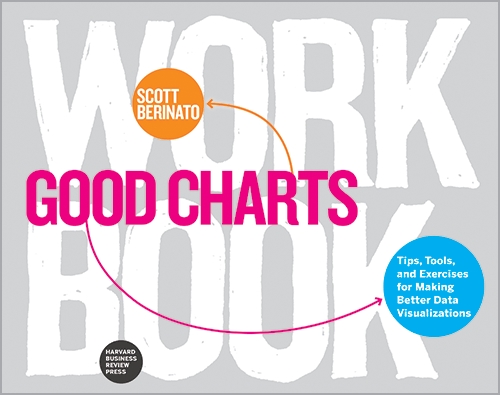
Good Charts Workbook: Tips, Tools, and Exercises for Making Better Data Visualizations


Good Charts Workbook: Tips, Tools, and Exercises for Making Better Data Visualizations
by Scott Berinato

A good visual representation of data can be invaluable for communicating the meaning behind the numbers. This book walks the reader through the thought process and choices in creating visualizations for a variety of cases. “It’s rare you don’t have to make a trade-off to create a good chart… Most of the time there isn’t one right answer, one right chart.” The main topics covered in the book are clarity, color, chart types, and persuasion.

Clarity. Berinato emphasizes decluttering to put the focus on what you want to communicate. “Take stuff away… Remove redundancy… Limit color and eye travel… Use your headline to describe the main idea of a chart, not its structure.”

Continue reading “Good Charts Workbook: Tips, Tools, and Exercises for Making Better Data Visualizations”

Organize for Complexity


Organize for Complexity: How to get life back into work to build the high-performance organization
by Niels Pflaeging

“As we have seen, the world has already changed—high complexity in value creation has become the norm.” This book proposes a cell-based organizational structure (Beta) better suited to a complex, unpredictable world than the traditional hierarchical system (Alpha). 

Continue reading “Organize for Complexity”

The Soft Edge: Where Great Companies Create Lasting Success


The Soft Edge: Where Great Companies Create Lasting Success
by Rich Karlgaard

It is noteworthy that a prominent business journalist from Silicon Valley—where technology and IPOs dominate headlines—wrote a book about the human factors of business success. “The yin and yang of effective management has always been about the search for the right spot between data truth and human truth.”

“Hard-edge execution is all about managing exactly to the numbers. The people who live on the hard edge of business are good at making the trains run on time. They focus on profit. Their language is time, money, and numbers. Every company in the world needs these employees.”

“Soft-edge excellence—in trust, smarts, teams, taste, and story—tends to attract loyal customers and committed employees.” Karlgaard says the soft edge is “the heart and soul” of your company.

Continue reading “The Soft Edge: Where Great Companies Create Lasting Success”

The Responsible Company


The Responsible Company: What We’ve Learned from Patagonia’s First 40 Years
by Yvon Chouinard and Vincent Stanley

We hear a lot about sustainability, but the authors contend “no human economic activity is yet sustainable… Responsible seems to us the apt, more modest, word to use… The term itself is necessary shorthand; there is no responsible company, only responsible companies of varying degrees, who act strategically to do less harm while improving, not sacrificing, the health of the business.”

Doing good and seeking profit are not incompatible. Wal-Mart’s initial environmental efforts were motivated by reputation management, “but removing excess packaging from deodorant sticks, concentrating laundry detergent in small bottles, and installing auxiliary power units in their trucks to reduce idling time turned out to save them millions of dollars.”

Continue reading “The Responsible Company”

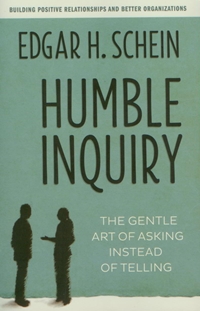
Humble Inquiry


Humble Inquiry: The Gentle Art of Asking Instead of Telling
by Edgar H. Schein (1928-2023)

Retired MIT Sloan School of Management professor Edgar Schein asserts, “Without good upward communication, organizations can be neither effective nor safe… Your organization may be underperforming because various employees or groups do not recognize the degree to which they are, in fact, interdependent.” The gist of this book is about creating a trusting environment with open communication across hierarchical boundaries. This entails less telling, more asking, and better listening.

“The U.S. culture is strongly built on the tacit assumptions of pragmatism, individualism, and status through achievement… Given those cultural biases, doing and telling are inevitably valued more than asking and relationship building. However, as tasks become more complex and interdependent, collaboration, teamwork, and relationship building will become more necessary. That, in turn, will require leaders to become more skilled in humble inquiry.”

Continue reading “Humble Inquiry”

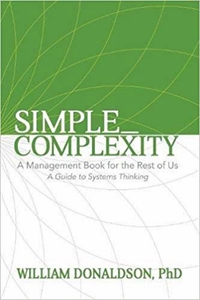
Simple Complexity: a Management Book for the Rest of Us, a Guide to Systems Thinking


Simple Complexity: a Management Book for the Rest of Us, a Guide to Systems Thinking
by William Donaldson

This book is about applying the principles of complexity and systems thinking to management. “Every organization is a system—in fact, a system of systems, perfectly designed to get the results it is getting today… Systems thinking is the unifying discipline that brings clarity to all of the other disciplines at work in your enterprise… The key, defining concept of systems thinking to remember is that nothing in the system is ever unconnected.”

Donaldson emphasizes the importance of context. “You have to ensure everyone has shared mental models of the enterprise and its management system… Remembering that context can enhance learning and comprehension by 50-100 percent, you must give employees context for both the part of the system they play a role in and the whole system.”

Continue reading “Simple Complexity: a Management Book for the Rest of Us, a Guide to Systems Thinking”