Why Can’t You Just Give Me The Number?


Why Can’t You Just Give Me the Number? An Executive’s Guide to Using Probabilistic Thinking to Manage Risk and Make Better Decisions
by Patrick Leach

Decisions can be based on a deterministic calculation only in conditions of certainty, that is to say the input parameters are known quantities. But strategic decisions are often made in a context of uncertainty and complexity, where a definite answer is unknowable, so we must turn to probabilistic thinking.

Uncertainty. “I make the case that all value generated by business executives comes—directly or indirectly—from how they manage uncertainty. Without uncertainty, a share of a company’s stock is effectively a bond, with guaranteed future cash flows. Guaranteed bonds don’t need management. But stocks (or rather, companies issuing stock) certainly do.”

Continue reading “Why Can’t You Just Give Me The Number?”
The Flaw of Averages


The Flaw of Averages: Why We Underestimate Risk in the Face of Uncertainty
by Sam L. Savage

This is a book about how to manage in a world of uncertainty. The beginning section presents a number of statistical concepts in simplified language; more sophisticated techniques follow. The author discusses how these concepts apply in a wide variety of contexts including oil exploration, pharmaceutical R&D, the stock market, the housing bubble, weather, climate change, health care, gene pools, the war of terror, and supply chains. He also describes some illogical accounting rules required by the FASB and the SEC.

Continue reading “The Flaw of Averages”

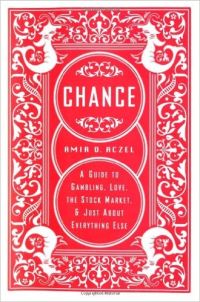
Chance

chance


Chance: A Guide to Gambling, Love, The Stock Market, and Just About Everything Else
By Amir D. Aczel (1950-2015)

This is a book about probability, the “quantitative measure of the likelihood of a given event.” The author applies probability theory in numerous scenarios.

Assuming a World War II pilot had a 2% chance of being shot down on each mission, what are the chances of a pilot being shot down in 50 missions?  Nope—it is not 50 x 0.02. Using the law of unions of independent events, the answer is 1 – 0.9850 = 64%.  In another example, there are three overnight couriers with an on-time record of 90%, 88%, and 92% respectively. If someone sent an important document using all three services, what is the probability of at least one of them delivering on time? The answer is 1 – (0.10 x 0.12 x 0.08) = 99.904%.

“So what have we noticed here?

Continue reading “Chance”

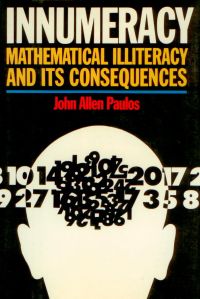
Innumeracy

innumeracy


Innumeracy: Mathematical Illiteracy and its Consequences
by John Allen Paulos

Innumeracy refers to mathematical incompetence. Given the frequency of misleading social media memes that simply don’t add up, I’d say the book is as relevant today as it was when published in 1988.

“If the headline reads that unemployment declined from 7.1 percent to 6.8 percent and doesn’t say that the confidence interval is plus or minus 1 percent, one might get the mistaken impression that something good happened. Given the sampling error, however, the ‘decline’ may be nonexistent, or there may even be an increase.”

Continue reading “Innumeracy”