Slow Productivity: The Lost Art of Accomplishment Without Burnout


Slow Productivity: The Lost Art of Accomplishment Without Burnout
by Cal Newport

Slow Productivity is “a philosophy for organizing knowledge work efforts in a sustainable and meaningful manner, based on the following three principles: 1. Do fewer things; 2. Work at a natural pace; 3. Obsess over quality.”

Newport defines knowledge work as “the economic activity in which knowledge is transformed into an artifact with market value through the application of cognitive effort.”

“Concrete productivity metrics of the type that shaped the industrial sector will never properly fit the more amorphous knowledge work setting… In knowledge work… individuals are often wrangling complicated and constantly shifting workloads… In this setting, there’s no clear, single output to track.”

Continue reading “Slow Productivity: The Lost Art of Accomplishment Without Burnout”

The Conclusion Trap: Four Steps to Better Decisions


The Conclusion Trap: Four Steps to Better Decisions
by Dan Markovitz

As a management consultant, Dan Markovitz has seen too many executives waste money on “Ready, Fire, Aim” decisions which yield no benefit—and sometimes even make things worse. “Frankly, I’m tired… of seeing leaders jump to conclusions and taking action without really understanding their problem.” This concise 67-page book resonates with me and I think it applies not only to business, but also more broadly to political policy on many of society’s complex issues, such as education and healthcare.

Continue reading “The Conclusion Trap: Four Steps to Better Decisions”

The Fifth Discipline


The Fifth Discipline: The Art and Practice of the Learning Organization
by Peter M. Senge

Senge writes, “I believe that, the prevailing system of management is, at its core, dedicated to mediocrity. It forces people to work harder and harder to compensate for failing to tap the spirit and collective intelligence that characterizes working together at their best.”

The subtitle is about the learning organization, but the book is also very much about systems thinking. 

Continue reading “The Fifth Discipline”

Authentic Leadership


Authentic Leadership: Rediscovering the Secrets to Creating Lasting Value
by Bill George

Former Medtronic chairman and CEO Bill George wrote this book following a series of corporate scandals, including Enron, Sunbeam, Tyco, and Worldcom—just to name a few. These companies imploded because management was fixated on maximizing short-term shareholder value.

To paraphrase my favorite line in the book: you are running a business, not a stock. That said, the compound annual growth rate of Medtronic split-adjusted stock price was 28.5% during George’s 12-year tenure, according to my calculations. Not too shabby!

The first part of the book deals with the character, values, and sense of purpose required to inspire employees. George also shares his wisdom and personal experiences regarding customers, quality, market share, growth, innovation, acquisitions, FDA approval delays, Wall Street analysts, and corporate governance.

Continue reading “Authentic Leadership”

An interview with Alastair Thomson author of Cash Flow Surge

After posting more than 250 book reviews, I decided to try something new: an author interview on YouTube. I am grateful to Alastair Thomson for graciously sharing his wisdom on managing small and medium-sized businesses. Alastair has an accounting background, but this conversation is not about debits and credits. It’s about improving your business from the perspective of an experienced CEO and CFO. We cover cash flow, profit, customer experience, metrics, business ethics, marketing, quality, continuous improvement, front-line employees, growth, margins, inventory, and receivables.


An interview with Alastair Thomson, author of Cash Flow Surge
July 16, 2020 – 1 hour – Book ReviewAmazon


Transcript

Continue reading “An interview with Alastair Thomson author of Cash Flow Surge”

Slack: Getting Past Burnout, Busywork, and the Myth of Total Efficiency


Slack: Getting Past Burnout, Busywork, and the Myth of Total Efficiency
by Tom DeMarco

Slack is an outstanding management book full of wisdom about corporate culture, change, failure, learning, quality, risk management, productivity, and managing people.

“You can’t grow if you can’t change at all.” Slack is “the lubricant of change… Slack represents operational capacity sacrificed in the interests of long-term health… Learning to think of it that way (instead of as waste) is what distinguishes organizations that are ‘in business’ from those that are merely busy.”

Continue reading “Slack: Getting Past Burnout, Busywork, and the Myth of Total Efficiency”

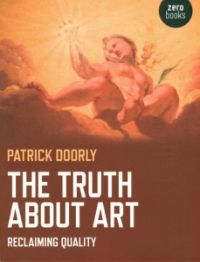
The Truth About Art: Reclaiming Quality

the-truth-about-art


The Truth About Art: Reclaiming Quality
by Patrick Doorly

“A bad work of art is an oxymoron, like bad skill,” writes Patrick Doorly, art history professor at Oxford University. “Art is high-quality endeavor.”

“Quality is not a thing but an event. When the subject [viewer] becomes aware of the object [art], quality describes the relationship that binds them… Beauty does not lie in the eye of the beholder, but that eye and the mind behind it form one half of the dynamic relationship we experience as beauty.”

The quality experience is preverbal. “It operates prior to intellectualization.”

Continue reading “The Truth About Art: Reclaiming Quality”

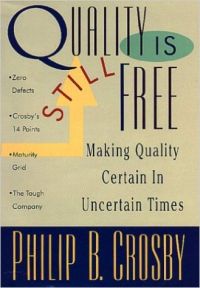
Quality Is Still Free

quality-is-still-free


Quality Is Still Free: Making Quality Certain in Uncertain Times
by Philip B. Crosby

Philip B. Crosby (1926-2001) created the Zero Defects performance standard. I only recently became aware of him through a reader comment on a Wall Street Journal article. Crosby joined ITT in 1965 as the conglomerate’s first director of quality. In 1979 he founded Philip Crosby Associates, a firm which trained 12,000 executives and managers through its Quality College.

“I built the Quality College around the Four Absolutes of Quality Management as they had evolved for me over the years:

  1. Quality means conformance to requirements, not goodness.
  2. Quality comes from prevention, not detection.
  3. Quality performance standard is Zero Defects, not Acceptable Quality Levels.
  4. Quality is measured by the Price of Nonconformance, not by indexes.”

“Quality is free” means it is cheaper to do things right the first time.

Continue reading “Quality Is Still Free”

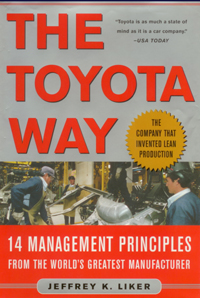
The Toyota Way

the-toyota-way


The Toyota Way
by Jeffrey Liker

The Toyota Way provides an excellent introduction of the Toyota Production System and insights into the company culture.

Toyota is the leader of lean production. In contrast to batch and queue systems, lean focuses on one-piece flow. The customer is the next process and the ideal batch size is one, so the source of defects can be discovered before thousands of defective parts are made.

Continue reading “The Toyota Way”