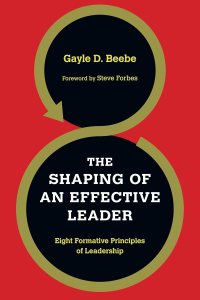
The Shaping of an Effective Leader: Eight Formative Principles of Leadership by Gayle D. Beebe
Westmont College president Gayle Beebe presents his eight principles of effective leadership and weaves in the wisdom of Peter Drucker, under whom he studied. The eight principles are character, competence, chemistry, culture, compatibility, convictions, connections, and commitment.
“Character is the foundation of all leadership responsibilities for all our life.” However, “without threshold competencies, even the most well-meaning individual can do real harm.”
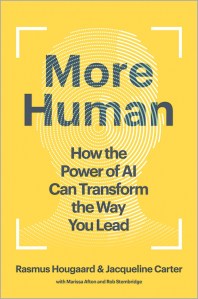
More Human: How the Power of AI Can Transform the Way You Lead by Rasmus Hougaard and Jacqueline Carter
“More human means leveraging AI to unlock the best of our humanity and, simultaneously, to help us overcome some of our limitations. This is the art of the toggle, where we skillfully navigate getting the best of both human capabilities and AI. In this way, we can develop ourselves as better human leaders and thereby create better and more-human workplaces.”
The authors quote Tim Cook, CEO of Apple: “I’m not worried about artificial intelligence giving computers the ability to think like humans. I’m more concerned about people thinking like computers, without values or compassion, without concern for consequence.”
Suffice it to say, I was curious about this anthology of 11 short articles about curiosity. Topics include creativity and exploration, managing complexity, professional relationships, listening, and corporate culture.
Orbiting the Giant Hairball: A Corporate Fool’s Guide to Surviving with Grace by Gordon MacKenzie
This book is about maintaining creativity within bureaucratic environments. Gordon MacKenzie worked as an artist at Hallmark Cards for 30 years, culminating in a role titled Corporate Paradox.
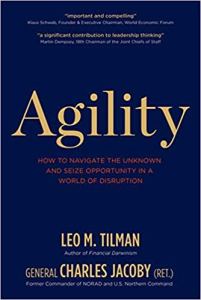
Agility: How to Navigate the Unknown and Seize Opportunity in a World of Disruption by Leo M. Tilman and Gen. Charles Jacoby (Ret.)
“The need for agility in business, government and warfare arises precisely from the uncertainty and complexity of the competitive environment.”
I imagine both co-authors of Agility have some battle scars—Tilman from Bear Stearns during the 2008 financial industry crisis and Jacoby from his career in the U.S. Army where he achieved the rank of 4-star general. Kidding aside, this book goes beyond military metaphors and presents a fusion of military and business thinking about risk intelligence and uncertainty as well as a leadership approach that emphasizes truth (as opposed to assumptions), trust, clear communication, and executional dexterity throughout the organization.
Complex adaptive systems “are constantly changing and evolving. They lack centralized control. They are inhabited by a multitude of stakeholders driven by distinct objectives, risk tolerances and modes of operation. These players interact in dynamic tension with one another, alternating between the urge to recoil from and engage in risk-taking and aggression. Their actions and adaptations lead to entirely unpredictable patterns and outcomes.”
Humans are Underrated: What High Achievers Know that Brilliant Machines Never Will by Geoff Colvin
“The number of people who wrongly believed they could never be replaced by a computer keeps growing.” So what are the skills in which humans can maintain a competitive advantage over machines?
“Skills of interaction are becoming the key to success… Now, as technology drives forward more powerfully every year, the transition to the newly valuable skills of empathizing, collaborating, creating, leading, and building relationships is happening faster than corporations, governments, education systems, or most human psyches can keep up with.”
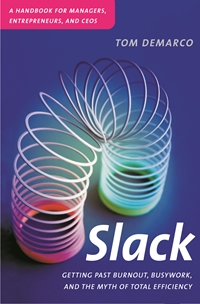
Slack: Getting Past Burnout, Busywork, and the Myth of Total Efficiency by Tom DeMarco
Slack is an outstanding management book full of wisdom about corporate culture, change, failure, learning, quality, risk management, productivity, and managing people.
“You can’t grow if you can’t change at all.” Slack is “the lubricant of change… Slack represents operational capacity sacrificed in the interests of long-term health… Learning to think of it that way (instead of as waste) is what distinguishes organizations that are ‘in business’ from those that are merely busy.”
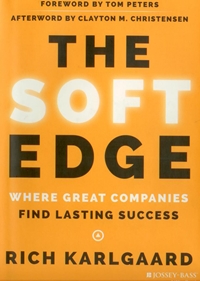
The Soft Edge: Where Great Companies Create Lasting Success by Rich Karlgaard
It is noteworthy that a prominent business journalist from Silicon Valley—where technology and IPOs dominate headlines—wrote a book about the human factors of business success. “The yin and yang of effective management has always been about the search for the right spot between data truth and human truth.”
“Hard-edge execution is all about managing exactly to the numbers. The people who live on the hard edge of business are good at making the trains run on time. They focus on profit. Their language is time, money, and numbers. Every company in the world needs these employees.”
“Soft-edge excellence—in trust, smarts, teams, taste, and story—tends to attract loyal customers and committed employees.” Karlgaard says the soft edge is “the heart and soul” of your company.



 The Key Point