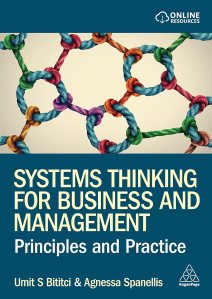
Systems Thinking for Business and Management
by Umit S. Bititci and Agnessa Spanellis
Organizations, markets, and economies are systems, analogous to ecosystems. This clearly-written, 278-page textbook written by professors from Edinburgh Business School and the University of Edinburgh introduces key concepts in systems thinking, including methods for modeling them and analyzing their behavior.
It is said that the purpose of higher education is to teach students to think. In this spirit, I believe future decisionmakers and policymakers would be well served by a course in systems thinking. I think every business school should include this subject in its curriculum.
“To understand the real value of systems thinking, we need to recognize that nothing in this world exists in isolation and that everything is connected to something else. Everything is affected by something and potentially affects something else. With systems thinking, one can begin to understand, explain, and predict why complex systems such as organizations, people, and societies behave the way they do.”
“A system is a collection of interacting parts/components/actors, in which the interactions result in system-level properties and behaviors not attributable to the sum of individual parts.”
BOUNDARIES. “If we look at only one part of the system, and ask how to improve the system, we get one set of answers. But this part does not exist in isolation… When we expand the boundaries of the system and when we look at the wider system, e.g. by including the customer in these boundaries and looking at what the customer does with our product, we get a different solution… In reality… the system boundary is an artificial concept to aid the analyst or the manager in conceptualizing and understanding the system.”
WICKED PROBLEMS. The authors explain the difference between tame, messy, and wicked problems. Tame problems have a correct answer and can be optimized. Most problems are messy; the remedy is usually a “good enough” solution involving compromise. Wicked problems have no solution; they can only be managed, not solved.
“In complex systems, problems that have the most significant impact, or in other words, problems that matter, tend to be wicked problems. Understanding these problems and quite often trying to revisit them requires understanding different systems and their interconnectedness. Therefore, taking a systems approach to understanding whole systems is absolutely essential in trying to manage these problems.”
HARD SYSTEMS. A car is an example of a hard system. “The key characteristics of hard systems are their predictable behaviors, caused by high-integrity parts that are connected through well-understood interactions. In this context, high-integrity parts mean that each part operates within tight tolerances and the amount of variation in each part is understood and predictable.”
SOFT SYSTEMS. “From a business and management perspective, all organizations are soft systems… i.e. human-centered systems, where people and their unpredictable emergent behaviors influence virtually all systems we are interested in.”
COMPLEX SYSTEMS. “Systems can be complicated or complex. When we talk about the complexity of systems, we really need to understand the difference between the two concepts… The term complex comes from the Latin word complexus, which means plaited or woven together.” For the purposes of this summary, let’s start with the idea that hard systems are generally complicated and soft systems are generally complex.
EMERGENCE. “Emergence is one of the most fascinating features of our universe and it is a key concept of [complex] systems. Emergence refers to the properties of the system that are caused by the interactions and relationships between elements rather than by the elements themselves… The traffic in our cities or the culture of a particular tribe or country emerges as a result of the individual beliefs and behaviors of each driver and person, i.e. component of the system, and their interactions—and often these are difficult to predict… Slums emerge.” I would add corporate culture to the examples of emergence.
CONCEPTUAL MODELING. “Building a convincing conceptual model involves capturing the key activities and other elements that shape the behavior of the system together with the logical links that connect the elements together.”
“The real value of soft systems modeling is to help us understand and model the social dimensions of the system, which helps us develop a profound understanding of why complex systems behave the way they do.”
“A causal loop diagram illustrates the causal relationships between the entities within a system… A positive causal link means that the two entities change in the same direction, e.g. both improving or both deteriorating. A negative causal link means that the two entities change in opposite directions, e.g. an improvement in one will cause deterioration in the other.”
“To make causal loop diagrams comprehensible and easier to follow, diagrams are usually accompanied by a narrative that explains what is happening.”
“The final but important part of building a conceptual model is to identify and agree on the measures of performance for the system… that enable us to evaluate and compare the current state of the system to any future improved state considering efficiency, effectiveness, efficacy.”
“An advantage of causal mapping is that it allows you to capture the complexity and richness of empirical material without reducing it. The map will enable you to zoom in on the identified problems or opportunities, a knock-on effect the problem might cause, as well as a potential cascade of subsequent triggered knock-on effects, which become visible through the causal links. You may ask what kind of mitigating actions and strategies or what kind of decisions, the organization has to make to address and mitigate the knock-on effect. Within this space, you start exploring and prioritizing alternative options.”
“Subsequently, you can zoom out to see a bigger picture and then choose another problem as the focal point of the map… This is particularly important when looking at organizational systems and addressing organizational issues. They never exist in isolation and are impacted by as well as impact other systems, such as other organizations, stakeholders, etc.”
STOCKS AND FLOWS. “Stocks are the measures of quantity at a given time… Flows are measures of quantity over time… Intangible things (knowledge, goodwill, resentment, misunderstanding, etc.) can also be represented as stocks and flows.”
FEEDBACK LOOPS. “Apart from flows, the connections between different parts of the system as well as between different systems can be understood through causal relationships, which sometimes form feedback loops.” Feedback loops can either be self-reinforcing or balancing. “Understanding these feedback loops is important, as they are essential features of causal loop diagrams.”
OPEN STRATEGY. “A new view of strategy emerged that is quite often referred to as open strategy. It advocates for building on the experience, capabilities, wisdom, and hunches of managers at different levels in the organization. Through the process of capturing their thinking about what the strategy of the organization should be, what the values of the organization are, what capabilities the organization has and what the organization is bad at, they also develop a sense of ownership of the strategy… Following this approach, the strategy is no longer pre-defined, but rather it becomes emergent and adaptable to the changing environment.”
When identifying priorities, “it is important to keep in mind that consensus is more important than compromise.”
“If the group discussion does not reach the space where consensus needs to be reached, it might mean that the discussion has not touched on the trade-offs. When trade-offs are brought up, participants become more involved and start talking about the alternatives, limited resources, prioritization. Mapping the complexity is only the start of the strategy-making journey. Deciding which option to take is where the real struggle with the strategy conversation is happening.”
COMPETENCE OUTCOMES. “Assets enable competences, which then lead to competence outcomes… Competence outcomes then enable delivering business goals, which leads to delivering customer value and, ultimately, delivering generic goals,” such as profit.
“Individual competences are rarely distinctive—distinctiveness arises through patterns or bundles of competences. Distinctive competences develop through networks of relationships between competences and organizational purpose. Unlike distinctive competences (DC), distinctive competence outcomes (DCO) cannot be managed directly—they are more externally focused and support business goals directly.”
“Historical and distinctive assets (DA) can be exploited by distinctive competences in order to achieve distinctive competence outcomes.” I am assuming a prime example of a historical asset is brand equity. The discussion of distinctive competences reminds me of Byran Sharp’s discussion of distinctive brand assets in How Brands Grow.
SYSTEM DYNAMICS. “One of the most commonly used methods for simulating behavior of complex systems is called systemdynamics. System dynamics builds on causal loop diagrams.”
“It is important to note that when we create these models, we make assumptions about how various autonomous parts (organizations/people) would behave in a given circumstance. Over time, as things unfold and we keep on comparing the model to how things are unfolding in reality, we can learn from this experience and refine the model. Therefore, the core value of modeling is not about developing a high-fidelity model. Instead, it is the PROCESS of MODELING that enables the modelers to learn more about the system as it emerges, thus making it more predictable.”
“A disruption may create a snowball effect and propagate to the entire network. Hence, a system dynamics approach provides an opportunity to analyze the ripple effects and evaluate the efficiency and effectiveness of the entire supply chain network.”
“Solutions in one system will most certainly have an impact on other systems, which might be both negative and positive, and failure to anticipate such impact will lead to unintended emergent behavior in different systems.”
“In complex systems, multiple elements interacting with each other create emergent properties and behaviors. These behaviors are sometimes counterintuitive, and this is what makes models of complex systems so valuable, because they can demonstrate and visualize these behaviors.”
CHANGING A SYSTEM. “We must recognize that all change initiatives consume resources… We should focus on finding the one simple change we can make that will have a profound effect on the behavior of the overall system”—also known as a trim-tab or a lever.
“The levers can be broadly grouped into four categories: structural, temporal, conceptual, and boundary levers. Most of the levers fall under the structural category. They are typically the easiest to identify and understand, but the impact of applying pressure to them tends to be less significant. The other types include the temporal levers that have to do with delays, the boundary levers that deal with the rules of the system, and the conceptual levers that are related to the goals and underlying assumptions. The latter are more difficult to recognize and then change, but they are the ones that would have the most profound impact on the system’s behavior.”
“Once we make a change to the system, the system is changed, and it would need to be restudied and reanalyzed in order for us to understand the new system and the new constraints.”
CONSTRAINTS. “The strength of a length of chain is determined by its weakest link, i.e. the constraint… An hour saved at a non-constraint is a mirage… It will have no effect on the overall system’s performance… An hour gained at the constraint is an hour gained for the whole system… In short before spending money, we should look to get everything out of the bottleneck by finding innovative ways of exploiting the constraint.”
RESILIENCE. “From the organizational perspective, the more self-organized the system is, the more resilient it is. If in a centralized system something happens to the central unit, the whole organization can stop functioning… Holacracy is a form of organization that distributes authority and decision making through a network of self-organized teams that are bound together with a shared purpose and common set of goals and rules.”
PLANNING FOR THE FUTURE. “Signals are observable examples of a change that might happen… while drivers are the trends or the force that power the signals and help explain what kind of change might happen in the future… When we combine signals and trends together, we can start thinking about the future in terms of scenarios.”
“When thinking about the future, it is more useful to try to imagine alternative futures rather than predict the future that will happen. Then we can start proactively thinking about how to make the more desirable future happen, and how to safeguard from the undesirable future.”
Bititci, Umit S., and Agnessa Spanellis. Systems Thinking for Business and Management: Principles and Practice. Kogan Page, 2024. Buy from Amazon.com
Note: I have modified the spelling to appease my American spellchecker.
Disclosure: As an Amazon Associate I earn from qualifying purchases. I received a review copy of this book.
RELATED READING:
- Scenario Thinking: Preparing Your Organization for the Future in an Unpredictable World by George Cairns and George Wright (2018)
- It’s Not Complicated: The Art and Science of Complexity in Business by Rick Nason (2017)
- Agent-based Modeling and Simulation by Simon JE Taylor (2014)
- The Goal: 40th Anniversary Edition: A Process of Ongoing Improvement by Eliyahu M Goldratt and Jeff Cox (2012)
- Making Strategy: Mapping Out Strategic Success by Fran Ackermann and Colin Eden (2011)
- Thinking in Systems by Donella H. Meadows (2008)
- Systems Dynamics: Systems Thinking and Modelling for a Complex World by John Sterman (2000)
- Theory of Constraints by Eliyahu M. Goldratt (1999)
- Learning to See: Value Stream Mapping to Add Value and Eliminate MUDA by Mike Rother and John Shook (1999)
Discover more from The Key Point
Subscribe to get the latest posts sent to your email.

 The Key Point