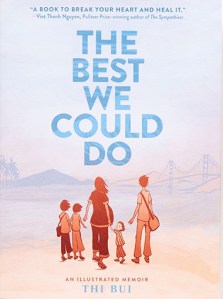
The Best We Could Do: An Illustrated Memoir


The Best We Could Do: An Illustrated Memoir
by Thi Bui

Thi Bui was born in Vietnam and immigrated to the United States as a child in 1978. Based largely on oral history from family members, she has written and illustrated their story, telling the history of Vietnam from 1943-1978 along the way. It is an engaging story presented in the style of a graphic novel.

Continue reading “The Best We Could Do: An Illustrated Memoir”

Mushrooms for Health and Longevity


Mushrooms for Health and Longevity
by Ken Babal, CN

This 60-page booklet explains the nutritional and medicinal benefits of 11 types of mushrooms: Agaricus, Chaga, Cordyceps, Coriolus, Enoki, Lion’s Mane, Maitake, Meshima, Reishi, Shitake, and Tremella. “There are 38,000 species of mushrooms. Species can differ greatly in their chemical content. For example, about 50 species of mushrooms are poisonous and another 50 demonstrate medicinal value.”

Continue reading “Mushrooms for Health and Longevity”

How Brands Grow


How Brands Grow
by Byron Sharp

This excellent, clearly-written book is based on empirical research covering market share, brand equity, price promotions, and advertising. It includes some counter-intuitive conclusions regarding customer retention, loyalty programs, segmentation, and competitor differentiation. Byron Sharp is the director of the Ehrenberg-Bass Institute for Marketing Science at the University of South Australia.

Continue reading “How Brands Grow”

Humans are Underrated: What High Achievers Know that Brilliant Machines Never Will


Humans are Underrated: What High Achievers Know that Brilliant Machines Never Will
by Geoff Colvin

“The number of people who wrongly believed they could never be replaced by a computer keeps growing.” So what are the skills in which humans can maintain a competitive advantage over machines?

“Skills of interaction are becoming the key to success… Now, as technology drives forward more powerfully every year, the transition to the newly valuable skills of empathizing, collaborating, creating, leading, and building relationships is happening faster than corporations, governments, education systems, or most human psyches can keep up with.” 

Continue reading “Humans are Underrated: What High Achievers Know that Brilliant Machines Never Will”

The Tyranny of Metrics


The Tyranny of Metrics
by Jerry Z. Muller

“This book argues that while they are a potentially valuable tool, the virtues of accountability metrics have been oversold, and their costs are often underappreciated.” There are chapters on the dysfunction of “metric fixation” in colleges and universities; schools; medicine; policing; the military; business; and philanthropy. Problems include gaming the system, costs exceeding benefits, and diverting effort from the core mission. A major theme is metrics as a substitute for competent judgment. 

Continue reading “The Tyranny of Metrics”

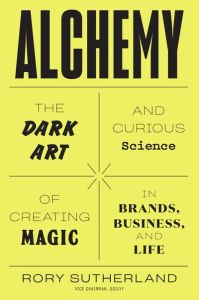
Alchemy: The Dark Art and Curious Science of Creating Magic in Brands, Business, and Life


Alchemy: The Dark Art and Curious Science of Creating Magic in Brands, Business, and Life
by Rory Sutherland

In Alchemy—published simultaneously in the U.K. with a punchier subtitle: The Surprising Power of Ideas that Don’t Make Sense—Sutherland writes with a humorous style filled with wisdom about consumer behavior, innovation, branding, hiring, the weakness of market research, and more.

Continue reading “Alchemy: The Dark Art and Curious Science of Creating Magic in Brands, Business, and Life”

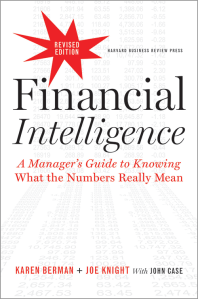
Financial Intelligence: A Manager’s Guide to Knowing What the Numbers Really Mean


Financial Intelligence: A Manager’s Guide to Knowing What the Numbers Really Mean
by Karen Berman and Joe Knight

This outstanding book teaches corporate financial literacy to nonfinancial employees. There are 33 short chapters grouped into sections covering the income statement, the balance sheet, cash, ratios, return on investment, and working capital. “You’ll learn how to decipher the financial statements, how to identify potential biases in the numbers, and how to use the information in the statements to do your job better.”

Continue reading “Financial Intelligence: A Manager’s Guide to Knowing What the Numbers Really Mean”

The Rouser Manifesto 2019


The Rouser Manifesto 2019

Rather than featuring a book in this post, I have selected a paper written by the team at the Swedish marketing firm Rouser.  The Rouser Manifesto takes a big-picture perspective on marketing effectiveness, calling out the problematic trend of focusing solely on short-term return on marketing investment (ROMI) while eroding brand equity.

Continue reading “The Rouser Manifesto 2019”

HBR Guide to Data Analytics Basics for Managers


HBR Guide to Data Analytics Basics for Managers

The objective of this book is to help managers make better data-driven decisions by working with data analysts and data scientists. The guide is a compendium adapted from 23 previously published Harvard Business Review and hbr.org articles.

“Framing a problem… is the most important stage of the analytical process for a consumer of big data. It’s where your business experience and intuition matter most. After all, a hypothesis is simply a hunch about how the world works. The difference with analytical thinking, of course, is that you use rigorous methods to test the hypothesis.”

Continue reading “HBR Guide to Data Analytics Basics for Managers”

Slack: Getting Past Burnout, Busywork, and the Myth of Total Efficiency


Slack: Getting Past Burnout, Busywork, and the Myth of Total Efficiency
by Tom DeMarco

Slack is an outstanding management book full of wisdom about corporate culture, change, failure, learning, quality, risk management, productivity, and managing people.

“You can’t grow if you can’t change at all.” Slack is “the lubricant of change… Slack represents operational capacity sacrificed in the interests of long-term health… Learning to think of it that way (instead of as waste) is what distinguishes organizations that are ‘in business’ from those that are merely busy.”

Continue reading “Slack: Getting Past Burnout, Busywork, and the Myth of Total Efficiency”