101 Things I Learned in Architecture School


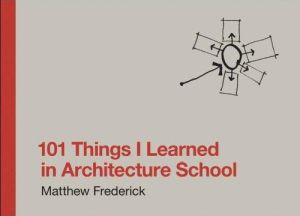
101 Things I Learned in Architecture School
by Matthew Frederick

Matthew Frederick presents 101 concepts in his “primer of architectural literacy.” Here is a sampling of his insights.

“Our experience of an architectural space is strongly influenced by how we arrive in it. A tall, bright space will feel taller and brighter if counterpointed by a low-ceilinged, softly lit space. A monumental or sacred space will feel more significant when placed at the end of a sequence of lesser spaces. A room with south-facing windows will be more strongly experienced after one passes through a series or north-facing spaces.”

Continue reading “101 Things I Learned in Architecture School”

101 Things I Learned in Engineering School


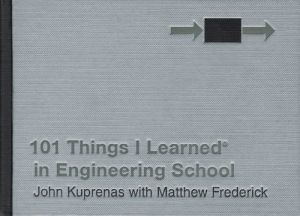
101 Things I Learned in Engineering School
by John Kuprenas with Matthew Frederick

Engineering involves the application of mathematics, physics, and chemistry, but “the heart of engineering isn’t calculation; it’s problem solving,” writes John Kuprenas, a civil engineer. Here is a sampling of his insights.

“There’s always a trade-off. Lightness versus strength, response time versus noise, quality versus cost, responsive handling versus soft ride, speed of measurement versus accuracy of measurement, design time versus design quality… It is impossible to maximize the response to every design consideration. Good design is not maximization of every response nor even compromise among them; it’s optimization among alternatives.”

Continue reading “101 Things I Learned in Engineering School”

The Death of Expertise


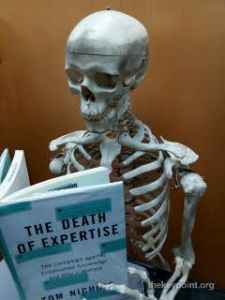
The Death of Expertise: The Campaign against Established Knowledge and Why it Matters
by Tom Nichols

This book is about the erosion of respect for facts, logical analysis, and critical thinking. Uninformed opinions carry the same weight as expert opinions. There is no vetting of dubious sources from credible sources. Beliefs are conflated with facts. It is in this climate that hoaxes, conspiracy theories, fake news, propaganda, and all manner of bullshit thrive. Tom Nichols, professor of national security at US Naval War College, examines this phenomenon and some of the causes, including higher education, technology, and the news media.

Continue reading “The Death of Expertise”

101 Things I Learned in Business School


101 Things I Learned in Business School
by Michael W. Preis and Matthew Frederick

The study of business spans “such diverse disciplines as accounting, communications, economics, finance, leadership, management, marketing, operations… and strategy.” This book provides a thumbnail overview of variety of such topics. Here’s a sample of ten items covered in the book.

Cash Flow vs. Profit. “Profitable, fast growing companies can be chronically short of cash. A business typically makes a sale before payment is received from the buyer, while the costs related to that sale, such as materials, labor, commissions, and overhead are borne up front. Consequently, a business that is profitable may be short of cash until payment is received. An especially fast growing company with rapidly increasing sales might be chronically short of cash. Procuring and maintaining adequate capital is crucial for businesses… Undercapitalization is among the most common causes of business failure. It can bring down an otherwise healthy organization.”

Continue reading “101 Things I Learned in Business School”

The Laws of Wealth


The Laws of Wealth: Psychology and the Secret to Investing Success
by Daniel Crosby

Psychologist Daniel Crosby works in the field of behavioral finance. “Given that you, as a member of the human family, have tendencies toward impatience, arrogance and a fetish for complexity, it is very likely that you will screw this up… At my last count, psychologists and economists had documented 117 biases capable of obscuring lucid financial decision-making.”

Crosby presents 10 rules of behavioral self-management.

Rule #1 – You Control What Matters Most. “The behavior gap measures the loss that the average investor incurs as a result of emotional responses to market conditions.” As an example, the author notes that the best performing mutual fund during the period 2000-2010 was CGM Focus, with an 18.2% annualized return; however the average investor in the fund had a negative return! The reason is that they tended to buy when the fund was soaring and sell in a panic when the price dipped. More on volatility later…

Continue reading “The Laws of Wealth”

Affordable Excellence: The Singapore Healthcare Story


Affordable Excellence: The Singapore Healthcare Story
by William A. Haseltine

The Singapore healthcare system produces world-class outcomes at half the cost of Western European countries and less than one-fourth the cost of the United States: Singapore spends 4% of GDP on healthcare; the United States spends 18%.  The World Health Organization ranked Singapore 6th in overall performance; the United States ranked 37th. (See page 200, The World Health Report 2000.)

Looking at costs of specific procedures, ”an angioplasty in the United States is almost $83,000, while in Singapore the cost is about $13,000. A gastric bypass in the United States is almost $70,000, while in Singapore the cost is $15,000. (These figures are in US dollars and include at least one day of hospitalization).”

This book explains how the system works.

Continue reading “Affordable Excellence: The Singapore Healthcare Story”

Narrative and Numbers


Narrative and Numbers: The Value of Stories in Business
by Aswath Damodaran

Aswath Damodaran is a professor of finance at NYU who has written several books on business valuation, including The Little Book of Valuation: How to Value a Company, Pick a Stock, and Profit.

In this book, he computes valuation based on the business narrative. “One of the most important lessons I have learned is that a valuation that is not backed up by a story is both soulless and untrustworthy and that we remember stories better than spreadsheets.” Conversely, “when a storyteller has wandered into fantasyland, the easiest way to bring him or her back to Earth is with data that suggests the journey is either impossible or improbable.” Thus, “you need to bring both stories and numbers into play in investing and business, and valuation is the bridge between the two.”

Continue reading “Narrative and Numbers”

You’re Not That Great


You’re Not That Great
by Daniel Crosby

Psychologist Daniel Crosby tells it like it is in this book about the numerous ways human nature can work against us, not the least of which is egoistic self-absorption (solipsism).

“The biggest finding to emerge from the self-esteem movement was that praise did not predict self-esteem, accomplishment did… Many of the theories about self-esteem that had impacted policy were simply junk science.”

Continue reading “You’re Not That Great”

Healthy Competition


Healthy Competition: What’s Holding Back Health Care and How to Free It
by Michael F. Cannon and Michael D. Tanner

Healthy Competition was published in 2005, but I pulled it off my shelf and reread it in early 2017, in the midst of the discourse about how to “repeal and replace” the Affordable Care Act (ACA, also known as Obamacare). Both the ACA and the proposed replacement focus on insurance, ignoring the exorbitant cost of health care in the United States. In this book, Cato Institute scholars Michael Cannon and Michael Tanner examine how the basic economic principles of price transparency, competition, and consumer choice could lower costs, reduce waste, and increase quality of care.

Continue reading “Healthy Competition”

The Art of Relevance

the-art-of-relevance


The Art of Relevance
by Nina Simon

This book explains how museums and other nonprofit organizations can expand audiences and build stronger connections with targeted communities. The author is executive director of the Santa Cruz Museum of Art & History (MAH).

“I believe relevance unlocks new ways to build deep connections with people who don’t immediately self-identify with our work. I believe relevance is the key to a locked room where meaning lives… Behind the door is a room that holds something powerful—information, emotion, experience, value… Relevance is the key to that door.”

“Instead of talking about ‘traditional’ approaches and ‘new’ ones, I find it more productive to talk about insiders and outsiders…”

Continue reading “The Art of Relevance”