100 Words Almost Everyone Confuses and Misuses
by the Editors of the American Heritage Dictionaries
Here are some examples of frequently misused words from the book.
Continue reading “100 Words Almost Everyone Confuses and Misuses”
100 Words Almost Everyone Confuses and Misuses
by the Editors of the American Heritage Dictionaries
Here are some examples of frequently misused words from the book.
Continue reading “100 Words Almost Everyone Confuses and Misuses”
Congratulations, By the Way: Some Thoughts on Kindness
by George Saunders
This book is an expanded version of a commencement speech to the Syracuse University class of 2013.
“What I regret most in my life are failures of kindness.”
Continue reading “Congratulations, By the Way: Some Thoughts on Kindness”
Team of Teams: New Rules of Engagement for a Complex World
by General Stanley McChrystal with Tantum Collins, David Silverman, and Chris Fussell
When General Stanley McChrystal took command of the Joint Special Operations Task Force in 2003, he was fighting a 21st-century war with a 20th-century military. This engaging book is about the reconfiguration which led to faster decisions and greater results. McChrystal’s mission was to defeat Al Quaeda in Iraq (AQI), but his leadership insights are applicable to business as well.
Continue reading “Team of Teams”
A Painter’s Progress: A Portrait of Lucian Freud
by David Dawson
A Painter’s Progress is a collection of 241 behind-the-scenes photographs taken by David Dawson, who was Lucian Freud’s assistant for nearly twenty years. Many of the photos taken in Freud’s studio include nude models, portrait sitters, and his whippets, Pluto and Eli. There are photos documenting several iterations of works in progress. Other photos include Freud viewing artwork in museums, meeting prominent people, having breakfast, and relaxing at home. There are also photos showing Freud’s posthumous exhibition being installed at the National Portrait Gallery in London.
The messy walls are a quirky feature of Freud’s studio.
Continue reading “A Painter’s Progress: A Portrait of Lucian Freud”
Disrupt Yourself: Putting the Power of Disruptive Innovative to Work
by Whitney Johnson
Clayton Christensen introduced the concept of disruptive innovation in The Innovator’s Dilemma, his seminal book which focused on the computer industry. His successive books applied the concept to health care and education. Now, Whitney Johnson writes about disrupting your own career.
Continue reading “Disrupt Yourself”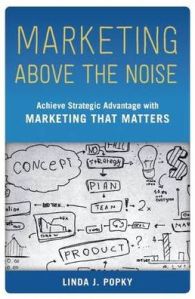
Marketing Above the Noise: Achieve Strategic Advantage with Marketing that Matters
by Linda J. Popky
Grounded in fundamentals and guided by strategic objectives, Linda Popky puts the hype around social media and big data in perspective. “It’s time to move the discussion away from today’s latest hot marketing tools and tactics to what really counts: convincing customers to trust you with their business—not just once, but time and time again.”
Continue reading “Marketing Above the Noise”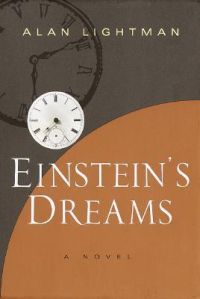
Einstein’s Dreams
by Alan P. Lightman
Einstein’s Dreams is historical fiction based on Albert Einstein’s study of the relativity of time, or time dilation. The book is formatted like a journal of Einstein’s dreams about 30 imaginary worlds where time functions differently. The book was written by Alan Lightman, a physicist and humanities professor at MIT. The author embeds observations on human behavior in these stories.
Continue reading “Einstein’s Dreams”
Art in the Age of Emergence
by Michael J. Pearce
Michael J. Pearce is an art professor who experienced a light bulb moment when he attended a talk in the philosophy department on the topic of emergence by guest speaker Philip Clayton. “Emergence, which describes the characteristics of forms that come out of complex systems, could apply especially well to how we experience art, how we understand aesthetics in relation to our evolving mind, and how we understand the creative process of making representational art… I suddenly realized that considering the relationship between emergence and consciousness could lead to a description of what distinguishes art objects from other things as we perceive them through our senses. Emergence allows us to define art!”
This book presents an interesting framework for thinking about art, although it is written in a dense academic style.
Continue reading “Art in the Age of Emergence”
Art and Courage: Stories to Inspire the Artist-Warrior Within
by John Paul Thornton
John Paul Thornton asks, “How will you impact the world?” While the book is not entirely autobiographical, the chapter about the author’s own paintings of missing children is the most powerful part of Art and Courage.
Continue reading “Art and Courage”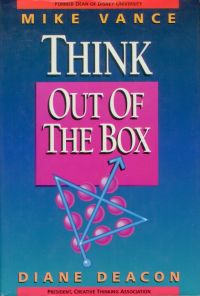
Think Out of the Box
by Mike Vance and Diane Deacon
People use the term “think out of the box” in reference to creativity, innovation, or unconventional approaches to solving a problem. I suspect many people who use this cliché have no idea where it came from.
The term was popularized in 1995 by the book Think Out of the Box. The box is a puzzle.

 The Key Point