Visual Intelligence: Sharpen Your Perception


Visual Intelligence: Sharpen Your Perception, Change Your Life
by Amy E. Herman

“Leonardo da Vinci attributed all of his scientific and artistic accomplishments to the same concept, which he called saper vedere—‘knowing how to see.’ We might also call his gift ‘visual intelligence.’”

Amy Herman, who has degrees in law and art history, teaches a course called the Art of Perception to police officers and FBI agents. The book is about how to assess, analyze, and articulate what we observe. To practice these skills, the author presents numerous works of art. She also discusses real-life crime and business cases.

Continue reading “Visual Intelligence: Sharpen Your Perception” →
Risk Savvy: How to Make Good Decisions


Risk Savvy: How to Make Good Decisions
by Gerd Gigerenzer

Gigerenzer makes a distinction between risk and uncertainty. He uses the term risk “for a world where all alternatives, consequences, and probabilities are known… Most of the time, however, we live in a changing world where some of these are unknown: where we face unknown risks, or uncertainty. The world of uncertainty is huge compared to that of risk… We have to deal with ‘unknown unknowns.’”

Continue reading “Risk Savvy: How to Make Good Decisions” →

The Progress Principle: Using Small Wins to Ignite Joy, Engagement, and Creativity at Work


The Progress Principle: Using Small Wins to Ignite Joy, Engagement, and Creativity at Work
by Teresa Amabile and Steven Kramer                  

“Inner work life influences people’s performance on four dimensions: creativity, productivity, work commitment, and collegiality… Inner work life matters for companies because, no matter how brilliant a company’s strategy might be, the strategy’s execution depends on great performance by people inside the organization.”

“To a great extent, inner work life rises and falls with progress and setbacks in the work. This is the progress principle and, although it may be most obvious on the best and worst days at work, it operates every day.”

The Progress Principle is the result of primary research by two psychologists who studied 238 knowledge workers from 26 teams in 7 companies representing 3 industries over the course of a team project—generally about 4 months. Participants submitted daily diary forms to the researchers confidentially. The authors cite some positive and negative scenarios, using pseudonyms to disguise the individuals and their employers.

Continue reading “The Progress Principle: Using Small Wins to Ignite Joy, Engagement, and Creativity at Work” →

Risk: Why We Fear the Things We Shouldn’t


Risk: Why We Fear the Things We Shouldn’t—and Put Ourselves in Greater Danger
by Dan Gardner

“One of the most consistent findings of risk perception research is that we overestimate the likelihood of being killed by the things that make the evening news and underestimate those that don’t. What makes the evening news? The rare, vivid, and catastrophic killers. Murder, terrorism, fire, and flood. What doesn’t make the news is the routine cause of death that kills one person at a time and doesn’t lend itself to strong emotions and pictures. Diabetes, asthma, heart disease.” 

Continue reading “Risk: Why We Fear the Things We Shouldn’t” →

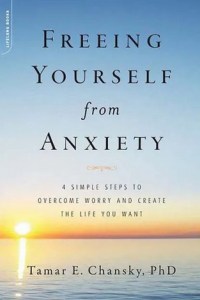
Freeing Yourself from Anxiety


Freeing Yourself from Anxiety: 4 Simple Steps to Overcome Worry and Create the Life You Want
by Tamar E. Chansky, Ph.D.

2020 has been a mentally-draining year. In this 287-page book, psychologist Tamar Chansky explains why our minds get overwhelmed with worry and she offers advice on how to deal with it. Here are some highlights.

Anxiety is “the first-reaction of a sensitive system that is wired to keep us alert to danger and protected from harm… But today, with our best interests in mind, anxiety sometimes makes mistakes, overshooting… grabbing your attention from what you need to focus on and insisting that you instead grapple with worst-case scenarios.” 

Continue reading “Freeing Yourself from Anxiety” →

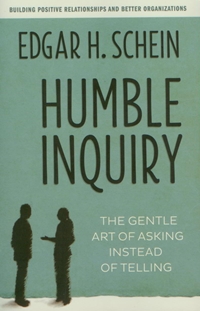
Humble Inquiry


Humble Inquiry: The Gentle Art of Asking Instead of Telling
by Edgar H. Schein (1928-2023)

Retired MIT Sloan School of Management professor Edgar Schein asserts, “Without good upward communication, organizations can be neither effective nor safe… Your organization may be underperforming because various employees or groups do not recognize the degree to which they are, in fact, interdependent.” The gist of this book is about creating a trusting environment with open communication across hierarchical boundaries. This entails less telling, more asking, and better listening.

“The U.S. culture is strongly built on the tacit assumptions of pragmatism, individualism, and status through achievement… Given those cultural biases, doing and telling are inevitably valued more than asking and relationship building. However, as tasks become more complex and interdependent, collaboration, teamwork, and relationship building will become more necessary. That, in turn, will require leaders to become more skilled in humble inquiry.”

Continue reading “Humble Inquiry” →

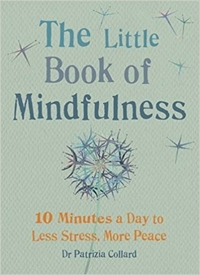
The Little Book of Mindfulness: 10 Minutes a Day to Less Stress, More Peace


The Little Book of Mindfulness: 10 Minutes a Day to Less Stress, More Peace
by Dr. Patrizia Collard

Dr. Patrizia Collard is a psychotherapist, stress management consultant, and lecturer at the University of East London.  She writes, “The goal of any mindfulness practice is simply to experience life as it unfolds. To stay present and calm and not slip back into thinking/worrying mode, we choose an anchor of awareness—a point of focus we direct our mind to.”

“Mindfulness is being aware of or bringing attention to this moment in time deliberately and without judging the experience. So, when we go for a mindful walk we really notice every little detail and all we encounter—trees, cars, flowers growing out of small cracks, or a cat crossing the road—rather than creating to-do lists.”

“When we procrastinate and distract ourselves with ‘busyness,’ we avoid engaging with the real thing—our lives… Living in the moment, and seeing everything afresh without judgment and worry lets us experience life rather than simply get through it.”

Continue reading “The Little Book of Mindfulness: 10 Minutes a Day to Less Stress, More Peace” →

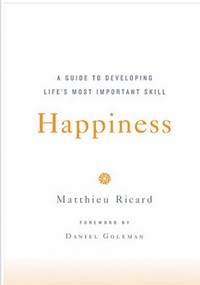
Happiness


Happiness: A Guide to Developing Life’s Most Important Skill
by Matthieu Ricard

Matthieu Ricard gave up a career in cellular genetics at the Institut Pasteur to study Buddhism in the Himalayas. In this book he shares his wisdom about happiness drawing from thirty-five years of studying Buddhism and psychology.

“A change, even a tiny one, in the way we manage our thoughts and perceive and interpret the world can significantly change our existence. Changing the way we experience transitory emotions leads to a change in our moods and to a lasting transformation of our way of being.”

Continue reading “Happiness” →

Choosing Civility


Choosing Civility: The Twenty-Five Rules of Considerate Conduct
by P.M. Forni

Choosing Civility is about counteracting the “coarsening of America.”  It was published in 2002, but is more relevant than ever.

“Being civil means being constantly aware of others and weaving restraint, respect, and consideration into the fabric of this awareness… When we approach others assuming that they are good, honest, and sensitive, we often encourage them to be just that.”

“Every act of kindness is, first of all, an act of attention… When we relate to the world as if we were on automatic pilot, we can hardly be at our best in our encounters with our fellow human beings.”

“Restraint is our inner designated driver. We all have it, and we all can learn to summon it whenever we need it… Restraint is an infusion of thinking—and thoughtfulness—into everything we do.”

Continue reading “Choosing Civility” →

The Decision Makeover


The Decision Makeover: An Intentional Approach to Living the Life You Want
by Mike Whitaker

The Decision Makeover is about replacing haphazard decision making with a mindful approach based on advancing our priorities. “Trial and error does not focus upon why each of our options makes sense in the big picture. The question should be: Does this choice best support my personal definition of success? … It takes discipline to ignore the noise and focus on only a few key goals. When we focus, things get done.”

Whitaker says that that we gain success momentum from a series of interdependent decisions. He describes the success formula waterfall: awareness, prime goals, decisions, dividends, momentum, success. “Good decision making allows you to pick up speed and make faster progress.”

Each year we make thousands of minor decisions, dozens of medium decisions, and perhaps one big decision. “Medium decisions are best illustrated as ‘course corrections’—like a boat captain. Since the boat’s destination is one of our big decisions… These medium decisions assure progress toward our success.”

Continue reading “The Decision Makeover” →