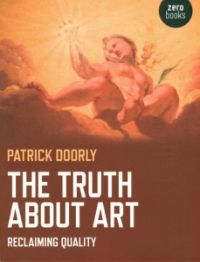
The Truth About Art: Reclaiming Quality by Patrick Doorly
“A bad work of art is an oxymoron, like bad skill,” writes Patrick Doorly, art history professor at Oxford University. “Art is high-quality endeavor.”
“Quality is not a thing but an event. When the subject [viewer] becomes aware of the object [art], quality describes the relationship that binds them… Beauty does not lie in the eye of the beholder, but that eye and the mind behind it form one half of the dynamic relationship we experience as beauty.”
The quality experience is preverbal. “It operates prior to intellectualization.”
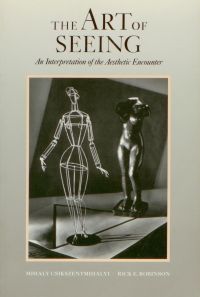
The Art of Seeing: An Interpretation of the Aesthetic Encounter by Mihaly Csikszentmihalyi and Rick E. Robinson
This book explores the enjoyment of viewing art within the framework of flow, the psychology of optimal experience. Flow is an intrinsically rewarding feeling of total involvement in an activity. To be fully engaged in a state of flow, one must be skilled and challenged. The author studied museum professionals as a proxy for the more general art viewing population.
“The experience is one of an initial perceptual hook followed by a more detached, intellectual appreciation that returns the viewer to the work with a deeper understanding.”
“The best examples of objects containing such challenges are works whose meaning appears to be inexhaustible.” As one respondent put it, “‘A good painting will never be used up.’”
Four dimensions of aesthetic experience are explored: cognitive, perceptual, emotional, and communicative.
“One of the most salient features of our culture is that there is so much bullshit.” Bullshit can refer to a number of things, including pointless tasks or requirements, but the main topic of this book is the widespread disregard for truth in speech and writing.
Fart Proudly: Writings of Benjamin Franklin You Never Read in School Compiled and Edited by Carl Japikse
Benjamin Franklin is well known as an important figure in American history. He was a printer, publisher, postmaster, inventor, and ambassador. He helped draft the Declaration of Independence and the Constitution. But he also had a sense of humor. This book contains a collection of his humorous writing, including hoaxes and political satire. Much of these works were written anonymously or under pseudonyms, such as a Richard Saunders, publisher of Poor Richard’s Almanack.
Here are some excerpts.
A Letter to the Royal Academy, 1781. The Royal Academy of Brusselles held a contest in which scientists submitted solutions to a given theoretical problem. Franklin submitted this suggestion for a contest theme with more practical value: “My Prize Question therefore should be, To discover some Drug wholesome and not disagreeable, to be mixed with our common Food, or Sauces, that shall render the Natural Discharges of Wind from our Bodies, not only inoffensive, but agreeable as Perfumes.”
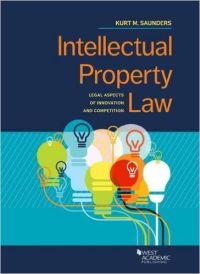
Intellectual Property Law: Legal Aspects of Innovation and Competition by Kurt M. Saunders, J.D., LL.M.
Intellectual Property Law covers trade secrets, patents, copyrights, trademarks, the right of publicity, protecting intellectual property internationally, and best practices for the handling of unsolicited ideas. Selected cases illustrate the legal theory with real-world conflicts, and explain the legal precedents established by the courts.
Although written as a business-school textbook, this book would also be a pertinent reference for professionals in a range of industries in the knowledge economy. Awareness of the law can help executives protect their rights and stay out of trouble.
In a global economy, how do you fight counterfeit products? What can you do about gray market sales? The chapter on international aspects explains the relevant treaties, notably the TRIPS Agreement, as well as the role of the WTO and the ITC.
What happens when a small business, which has been using a common law trademark for 50 years, is sued for infringement by a newer company which has registered the trademark with the USPTO? The answer is that concurrent use is allowed until the federal trademark owner competes directly. One of the purposes of trademark law is to prevent confusion in the mind of the consumer as to the origin of the product.
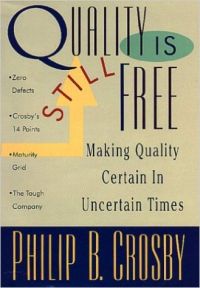
Quality Is Still Free: Making Quality Certain in Uncertain Times by Philip B. Crosby
Philip B. Crosby (1926-2001) created the Zero Defects performance standard. I only recently became aware of him through a reader comment on a Wall Street Journal article. Crosby joined ITT in 1965 as the conglomerate’s first director of quality. In 1979 he founded Philip Crosby Associates, a firm which trained 12,000 executives and managers through its Quality College.
“I built the Quality College around the Four Absolutes of Quality Management as they had evolved for me over the years:
Quality means conformance to requirements, not goodness.
Quality comes from prevention, not detection.
Quality performance standard is Zero Defects, not Acceptable Quality Levels.
Quality is measured by the Price of Nonconformance, not by indexes.”
“Quality is free” means it is cheaper to do things right the first time.
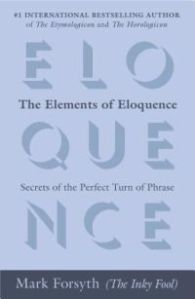
The Elements of Eloquence: Secrets of the Perfect Turn of Phrase by Mark Forsyth
The Elements of Eloquence is about “the figures of rhetoric, which are the techniques for making a single phrase striking and memorable… They are the formulas for producing great lines.” Mark Forsyth writes with a sense of humor and he quotes examples from The Beatles, John F. Kennedy, Shakespeare, and Yoda.
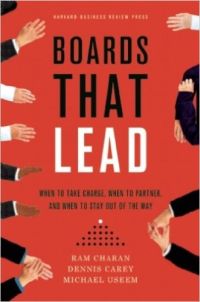
Boards that Lead: When to Change, When to Partner, and When to Stay Out of the Way by Ram Charan, Dennis Carey, Michael Useem
“A board can be a destroyer or a creator of value.” This book presents an excellent analysis of how the inept boards of Hewlett-Packard, Motorola, and AIG destroyed shareholder value; interesting insights into the turnarounds of Apple and Tyco; CEO succession at Ford, 3M, and GlaxoSmithKline; and Procter & Gamble’s acquisition of Gillette.
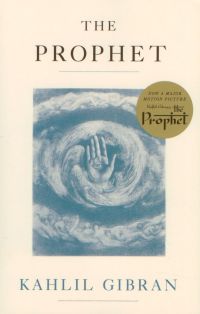
The Prophet offers wisdom on 26 topics—about three pages on each. Gibran writes in poetic prose with a liberal use of archaic words, presumably to sound biblical. Some of the meaning is immediately clear, while other parts require some reflection to decipher the deeper meaning.
On Work. The author stresses the importance of finding work you enjoy. “For if you bake bread with indifference, you bake a bitter bread that feeds but half man’s hunger. And if you grudge the crushing of the grapes, your grudge distils a poison in the wine.”
On Marriage. Gibran observes that marriage is a union between individuals, not a merger. “Let there be spaces in your togetherness, and let the winds of the heavens dance between you… The oak tree and the cypress grow not in each other’s shadow.”
Everybody Writes: Your Go-To Guide to Creating Ridiculously Good Content by Ann Handley
Everybody Writes is a catchy title, although a more accurate one would be Writing Tips for Content Marketing.
Here’s the secret formula: “The multiplication signs are important, because if the value of any one of these things (Utility, Inspiration, or Empathy) is zero, then the sum of your content is a big fat zero, too… Utility x Inspiration x Empathy = Quality Content.” I think she means product—not sum—but I like the idea.


 The Key Point