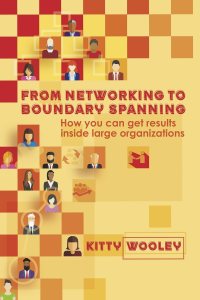
From Networking to Boundary Spanning: How You Can Get Results Inside Large Organizations
by Kitty Wooley
At its essence, this is advice to early-career employees from a retired U.S. federal government employee who rose through the ranks by taking initiative, making connections beyond her workgroup, and establishing herself as a go-to person to get things done. On another level, this is a call-to-action to shake up the organizational culture of large bureaucracies to make them more effective—and more fulfilling to work in.
SILOS. On a farm, silos are cylindrical towers used to store grain. In the workplace, the term is a metaphor to describe departments that operate separately with minimal communication and cooperation, rather than as part of an integrated whole.
“Siloed behavior exacts a high cost on organizations, governments, and society.”
Siloed behavior is not unique to government. “When I later served on the board of a local chapter of the Association for Talent Development, lunch conversations with colleagues who worked at large insurance companies about the lack of empowerment were indistinguishable from similar conversations with government colleagues. I realized that size was more relevant than sector—people clam up and play safe in large organizations.”
WHAT IS BOUNDARY SPANNING? “Networking and boundary spanning are closely related… The networker’s relationships often result directly from connecting with someone who is perceived as a potential career resource. The boundary spanner’s relationships are often a byproduct that results from the process of reaching across silos to ask a question, offer assistance, or learn from someone else.”
“Boundary spanning is a lubricating, niche capability that enables its practitioners to get uncommon, win/win results for their organizations and themselves.”
“Boundary spanning is uncommon, bordering on rare, because there aren’t that many people who do the thinking and take the initiative to reach across in service to the mission.”
BOUNDARY SPANNING AT ALL LEVELS. “For organizations to realize the true power of cross-boundary cooperation and collaboration, boundary spanning behavior has to be allowed, encouraged, and normalized at all levels… Productive boundary spanning can occur from any position.”
ORGANIZATIONAL CULTURE. “Bureaucratic culture shoots itself in the foot by constraining connectivity unnecessarily… Think about those whose urge to reach across has been stymied. Far from participating in cross-boundary work, they have been discouraged even from crosscutting conversations inside the organization that would help them understand what the real problems are, so that their creative juices could begin flowing and they could begin thinking about potential solutions that top leaders could be overlooking.”
PERSONAL AGENCY AND EMPLOYEE ENGAGEMENT. “My observation simply is that when people exercise more agency on the job, they contribute more, and their work has more potential to be satisfying. Boundary spanning at work is about expanding one’s own agency to get work done better.”
“Increased employee engagement is an outcome of boundary spanning practice simply because people relish novel work challenges, having their unique gifts recognized and tapped, and participating meaningfully in something bigger than themselves.”
ALIGNMENT. “In order to get results that matter to the organization (and not just to you), you have to know what its leaders are trying to achieve.”
“Rather than waiting endlessly for others to realize what you know and can do, you could take a deep dive into alignment—that is, find out what each part of the organization is trying to accomplish—and think about how what you really do could help. Most stubborn problems take years to solve because they cross organizational silos that few people are adept at crossing. Solutions take years because individuals at all levels tend to be uncomfortable with boundary spanning, even though having useful networks is becoming a popular idea.”
“Alignment as risk mitigation… If at all times you can explain how your actions align with what the organization is seeking to accomplish, it is very unlikely that someone of ill will can harm you without revealing and embarrassing themselves.”
GUARDRAILS. “Think of guardrails as reminders of what NOT to do that provide freedom of movement while protecting an employee from harm, like steel highway barriers along the other edge of narrow mountain roadways.”
“Organizations that have attempted to retrofit so-called high-potential employees would probably see more of the change they want, at less cost, by having managers create guardrails for all employees. Guardrails would make it easier for natural connectors to do what they do best, as well as for others who like to try their hand at boundary spanning.”
TACIT KNOWLEDGE. The author quotes Helen Bevan of the UK National Health Service: “As much as 80% of the knowledge in an organization is undocumented. That’s why networks, communities of learning/practice and sharing conversations are often more effective than good practice repositories, portals, metadata, or search systems.”
She also quotes Dion Hopkins of U.S. Army Training and Doctrine Command: “By recognizing the value of tacit knowledge, organizations can create environments that facilitate sharing through mentorship, collaborative practices, and informal interactions, ultimately fostering innovation, better decision-making, and a more resilient knowledge ecosystem.”
WEAK TIES. “I think Deborah Meehan and Claire Reinelt have it right: ‘A network is a set of relationships that are characterized by both strong and weak ties. Strong ties are characterized by high levels of trust, reciprocity, and sense of community, whereas weak ties cross boundaries and are a source of new ideas, information, and resources.’”
“See that secretary over there? …. If you see her as ‘just’ a secretary, you are less likely to get far… If you see her as Ms. Carolyn Potter, who has worked for the last three company presidents in the same position, you’re coming along—do you have any idea of the encyclopedic knowledge she possesses about all aspects of the organization?”
CAREER GROWTH. “What silo-crossing is really about is enhancing your confidence in your own ability to plug into new situations and begin adding value. That comes from being comfortable initiating contact with colleagues you don’t know, which at the same time quietly prepares you to hold your own in conversations with senor leaders, another career benefit.”
“A huge benefit of reaching across to others outside your team for conversation about the work is that you’ll understand more deeply the work of other units and how it relates to your work, and to that of the organization as a whole. While you’re at it, you’ll discover the subtle differences in how each unit operates. The familiarity will prepare you to be invited into larger conversations. It also will make it more likely to that you will begin to identify future opportunities and potential mentors.”
INTEGRITY. “Our desire to be persons of integrity and to take responsibility for our actions is the bedrock that attracts others who have integrity and take responsibility.”
PREPARATION. “I mention preparation because it makes what we think of as ‘luck’ more likely to occur… Preparation signals respect… Productive workplace relationships hinge on respect, not necessarily friendship, although you may make some long-lasting friends along the way.”
INTROVERTS. “By definition, you will feel some discomfort when you put yourself way out there. The word that occurs to me most often, when I’m in that space, is ‘unsettled’ … After a few hours, the feeling subsides… My energy is introverted… Extroverts may have a different experience.”
LEADERSHIP. “When I retired, there were about 7,000 Senior Executive Service (SES) members for roughly 2 million civilian federal employees… There’s a limit to how many plates one leader can keep spinning at once. Your goal could be to do more allowing, enabling, or encouraging, depending on what your direct reports are willing to learn and do.”
“Chris Fussell, the Navy Seal who served with General Stanley McChrystal in Iraq and co-authored Team of Teams with him, expresses the fundamental objective extremely well: ‘A leader’s job, rather than appointing boundary spanners, is to create an environment where any individual in the organization can connect the dots, and choose to become a boundary spanner themselves.’”
“Mary Parker Follett once said, ‘Leadership is not defined by the exercise of power but by the capacity to increase the sense of power among those led.’ Look for people who think like that, and become one of those leaders to the best of your ability. It will attract a higher caliber of colleague to you and make your boundary spanning more fruitful.”
MISSION COMMAND VS. DETAILED COMMAND. “Mission command and detailed command were theorized by a 19th-century Prussian chief of staff who realized that battlefield situations changed too quickly and were too uncertain for micromanagement to work. Instead, what would work was if commanders issued a clear mission and intent and gave subordinates freedom to achieve it using their own initiative, fostering trust and adaptability. In the 20th century, the U.S. Army arrived at a similar understanding.”
“It does not make sense to me that, when the stakes are life and death, military commanders can flex between detailed command and mission command as the situation requires, whereas many civilian government and corporate leaders seem unequipped ever to flex, instead remaining in detailed command, also known as micromanagement. Such leaders are not as well-equipped to deal with change, complexity, and uncertainty.”
“The micromanaging behavior of detailed command and control thwarts knowledge transfer, detracts from high performance, and causes people to leave.”
TALENT PIPELINE. “If employees practice to the point of ease so that they do not hesitate when the organization asks them to connect across silos to get work done better, or needs volunteers to contribute as leaders or followers in an important interagency challenge, they add to the organization’s capability and agility, and potentially its leadership pipeline.”
REDUCING CHURN. “One problem large organizations face is that able young employees who are recruited with great effort often don’t stay long. Sometimes they leave when they aren’t extended the autonomy and trust that befits their adult status. When employees’ unique gifts intersect with crosscutting problems, whether complex and public-facing… or internal to the organization, positive energy is released. That increases their engagement and can lead to a flood of new ideas. One way to slow down the revolving door is to encourage relationships both within and across departments, so that people meet colleagues elsewhere and learn about their work. Even if employees later decide to change departments, the organization has a vested interest in not losing them altogether.”
IDENTIFYING WORTHWHILE DIRECTIONS. “Willingness to learn—I lump this with curiosity—is a catalyst for boundary spanning opportunity.”
“If you see a project that looks cool from the outside, find out more about it and try to strike up a conversation with a project team member or two. Later, try to understand what about it attracted you. That will increase your self-knowledge, which will help you make better decisions about your work and career path, which will get you closer to career happiness. Create a virtuous circle.”
“Understanding what other parts of the organization need to accomplish, and what’s causing them pain, is huge… For example, do you know that many large IT projects around the world have failed because the employees in charge of programs and the employees who develop technologies to support the programs didn’t understand what the others needed in order to achieve their objectives?”
“If you understood both groups, maintained a constrictive attitude, and desired to contribute, you could become someone who could volunteer or be enlisted to translate back and forth and connect people, so that the solutions would be jointly shaped and have a better chance of succeeding… That can occur even without your being an expert in either the program or the technology—the expertise you bring is the translation and connection itself.”
Wooley, Kitty. From Networking to Boundary Spanning: How You Can Get Results Inside Large Organizations. s.p., 2026. Buy from Amazon.com
Disclosure: As an Amazon Associate I earn from qualifying purchases.
Selected authors mentioned:
- Right Kind of Wrong: The Science of Failing Well by Amy C. Edmondson (2023)
- Relationships That Work: 4 Simple Steps to Building Intentional Connections in Business and Life by Alex Tremble (2023)
- Context, Context, Context: How Our Blindness to Context Cripples Even the Smartest Organizations by Barry Oshry (2018)
- The Fearless Organization: Creating Psychological Safety in the Workplace for Learning, Innovation, and Growth by Amy C. Edmondson (2018)
- The Connected Company by Dave Gray and Thomas Vander Wal (2015)
- Team of Teams: New Rules of Engagement for a Complex World by General Stanley McChrystal with Tantum Collins, David Silverman, and Chris Fussell (2015)
- Teaming: How Organizations Learn, Innovate, and Compete in the Knowledge Economy by Amy C. Edmondson (2012)
- Boundary Spanning Leadership: Six Practices for Solving Problems, Driving Innovation, and Transforming Organizations by Chris Ernst and Donna Chrobot-Mason (2010)
- Seeing Systems: Unlocking the Mysteries of Organizational Life by Barry Oshry (2007)
- Mary Parker Follett Prophet of Management edited by Pauline Graham (2003)
- Dynamic Administration: The Collected Papers of Mary Parker Follett (originally published in 1940)
Discover more from The Key Point
Subscribe to get the latest posts sent to your email.


