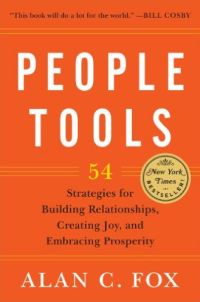
People Tools: 54 Strategies for building relationships, creating joy, and embracing prosperity by Alan C. Fox
Alan C. Fox writes with the tone of a grandfather sharing advice. Each “people tool” is described in a two to four page chapter, making it easy to read in small increments of spare time. Here is a sampling:
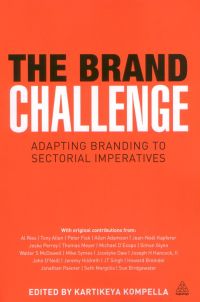
The Brand Challenge: Adapting Branding to Sectorial Imperatives Edited by Kartikeya Kompella
The Brand Challenge consists of four general branding topics followed 11 sector-specific chapters, namely: luxury, retail, business-to-business (B2B), media, financial services, non-profits, fashion, hotels, cities, technology, and football (soccer). Each chapter is written by a different author.
Fans Not Customers: How to Create Growth Companies in a No Growth World by Vernon W. Hill II with Bob Andelman
Vernon W. Hill II founded Commerce Bank in 1973. In 2007, the bank “was sold to Toronto-based TD Bank for $8.5 billion, producing a 30-year, 23 percent annual shareholder return. Everyone profited, including shareholders and team members.” In 2010, he co-founded Metro Bank, bringing the same service culture to British banking. In Fans Not Customers he reveals the secret sauce of his business model. This book is about branding, differentiation, corporate culture, and organic growth, but the dominant theme is providing exceptional customer service.
My Life as a Street Painter in Florence, Italy by Kelly Borsheim
American sculptor Kelly Borsheim is living her dream, working as an artist in Florence, Italy (or Firenze as the city is called in Italian). She first visited Florence to see the marble sculptures of Michelangelo in person. Once there, she discovered the world of the Madonnari, meaning street painters. (Madonnaro is masculine singular. Madonnara is feminine singular.)
The Tao of Pooh is about “how to stay happy and calm in all circumstances.” Benjamin Hoff uses the characters and stories from Winnie-the-Pooh and The House at Pooh Corner to explain basic concepts of Taoism. He also brilliantly integrates his own brief dialogue with the characters as segues into explanations of Taoist principles. Tao (pronounced DAO) means “the way.”
Managing the Unexpected: Assuring High Performance in an Age of Complexity by Karl E. Weick and Kathleen M. Sutcliffe
University of Michigan business school professors Weick and Sutcliffe studied common management attributes of “high reliability organizations” (HROs) such as aircraft carriers and nuclear power plants, where glitches can have deadly consequences. “The key difference between HROs and other organizations in managing the unexpected often occurs in the earliest stages, when the unexpected may give off only weak signals of trouble… Managing the unexpected is about alertness, sensemaking, updating, and staying in motion.”
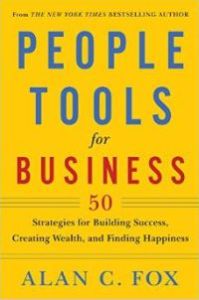
People Tools For Business: 50 Strategies for Building Success, Creating Wealth, and Finding Happiness by Alan C. Fox
Alan C. Fox writes with the tone of a grandfather sharing lessons learned “in business and in life,” drawing from more than forty-five years of experience as a lawyer and commercial real estate investor. There are 50 brief chapters.
Fox shares a great metaphor explaining the difference between a short-term transactional attitude and a long-term relationship building approach. “Not every sales call, or every contact, results in a sale. And each sale does not always produce a profit. I read an article in the Wall Street Journal that compared the American style of business to the Asian model. Americans were described as hunters, with the goal of making as much profit as possible from a single kill. The Asian model was more like farming—cultivating the fields of their business relationships.”
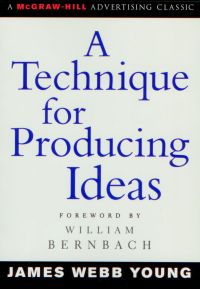
A Technique for Producing Ideas by James Webb Young
This concise booklet was first published in the 1940s by James Webb Young, who became vice president of the advertising firm J. Walter Thompson and the first chairman of The Advertising Council. He wrote it in response to the question, “How do you get ideas?”
Before explaining the process, Young presents two principles.
Lama Marut, aka Brian K. Smith, was a professor of comparative religion, he studied Hinduism and Sanskrit in India, he was a Buddhist monk, and he is the son of a Baptist preacher. So he presents a well-informed viewpoint rather than a myopic dogma. Fortunately, you don’t need to climb a mountain to be enlightened by this wise man; he imparts wisdom in his book, Be Nobody.
Marut writes about living in the iEra. “Our contemporary culture of consumerism, materialism, narcissism, and the worship of fame encourages the idea that we will be happy only when we become exceptional. But maybe we’ve got it wrong—exactly wrong. Maybe our deepest and most authentic happiness will be found only when we finally lay down this heavy burden of trying to be a somebody… Maybe true fulfillment in life requires an emptying, not a filling.”
101 Souls Facing Forward by John M. Crowther (1939-2018)
When we think about history, especially ancient history, the vast spans of time can become a blur. In his book 101 Souls, John Crowther provides a new framework which puts history in the context of lifetimes. “Imagine a line of people stretching back through time to the beginnings of what we think of as civilization… 6000 years ago. Consider that each individual was born the year that the preceding individual dies, and that each lived to be 60 years old.” Simple math reveals that there would be only 100 lifetimes separating us from the beginning of civilization.






 The Key Point