In Defense of Food: An Eater’s Manifesto by Michael Pollan
“Most nutritional advice we’ve received over the last half century has actually made us less healthy and considerably fatter…[Americans] suffer substantially higher rates of cancer, cardiovascular disease, diabetes, and obesity than people eating any number of different traditional diets.”
Rethinking Reputation: How PR Trumps Marketing and Advertising in the New Media World by Fraser P. Seitel and John Doorley
This book gets off to a weak start. Chapter one is not about reputation management. It’s about how a couple of NYU students launched a shoe company on a shoestring budget. (Hint: Find a patent attorney who will work for you without charge.) Chapters three and five sound like they could have been written by publicists for Merck and Johnson & Johnson. In fact, coauthor John Doorley has held positions at both firms (and he teaches at NYU). The chapter on T. Boone Pickens’ energy independence campaign states that he spent $100 million “with more than half focused on paid media.” That seems to undermine premise of the subtitle.
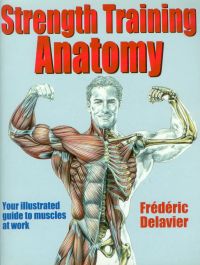
Is your New Year’s resolution to hit the gym, but you don’t really know what to do once you get there? With Strength Training Anatomy, a picture really is worth 1000 words.
Each page features an illustration of an exercise being performed, with the targeted muscles drawn in red and labeled. Most of the exercises use either free weights or a weight-training machine; there are some exceptions, such as crunches. Each page also includes written instructions. See the sample page below.
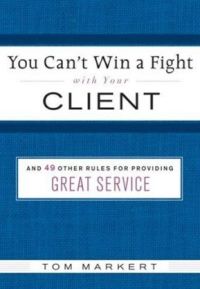
You Can’t Win a Fight with Your Client and 49 Other Rules for Providing Great Service by Tom Markert
This book is about managing client relationships in a service economy, with a focus on the role of the account manager. The author was CEO of a market research firm serving Fortune 500 clients. To illustrate the importance of the account manager role, he quotes the CEO of a consumer goods company which derives 40% of its business from Wal-Mart: “If we are not servicing them just right… our business is dead.” The book offers 50 tips, each presented in an easily digestible two or three page chapter.
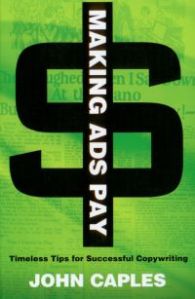
Making Ads Pay: Timeless Tips for Successful Copywriting by John Caples (1900-1990)
John Caples was a pioneer of direct-response copywriting. In Chapter 8 he presents as series of paired ads which were tested, followed by analysis of why the winning ads outperformed. The winner often outperformed the other by a wide margin—up to five times as many responses.
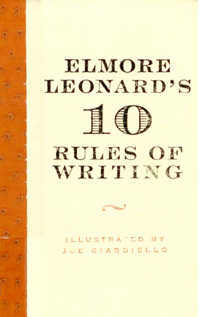
Elmore Leonard’s 10 Rules of Writing offers good advice about writing fiction, although the implicit theme pertains to any writing. Essentially, don’t let your writing style distract from what you are trying to say.
My favorite tip is #10: “Try to leave out the part that readers tend to skip.”
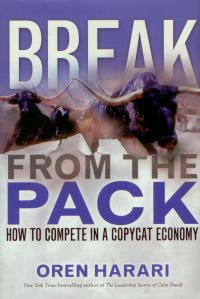
Break From the Pack: How to Compete in a Copycat Economy by Oren Harari
Break-from-the-pack companies are analogous to the small cluster of runners at the front of a marathon. The Copycat Economy is analogous to the majority of runners who lag behind. In the words of former IBM CEO Sam Palmisano, “Either you innovate or you’re in commodity hell. If you do what everybody else does, you have a low-margin business.”
My Life in Advertising and Scientific Advertising by Claude C. Hopkins (1866-1932)
Claude C. Hopkins was a pioneer in the advertising industry. This volume consists of his two books: Scientific Advertising, written in 1923, and My Life in Advertising, written in 1927. NBC and CBS were founded around the time of Hopkins’ retirement, so his work predated the broadcasting era. The media of his time were newspapers, magazines, and direct mail.
“Salesmanship-in-print is exactly the same as salesmanship-in-person.” If the purpose of advertising is to sell, then its effectiveness can be measured by resulting sales volume. Hopkins tested ads on a small scale before risking money on a large-scale campaign. He also compared results using different headlines in order to discover the best performing approach.
The Experience Economy: Work is Theatre & Every Business is a Stage by B. Joseph Pine II and James H. Gilmore
The Experience Economy is about the progression of economic value:
Commodities – coffee beans
Goods – ground coffee
Services – a cup of coffee at a diner
Experiences – cup of coffee at a fine restaurant or trendy café
“Commodities are fungible, goods are tangible, services intangible, and experiences memorable… The easiest way to turn a service into an experience is to provide poor service.”
Think India: The Rise of the World’s Next Great Power and What It Means for Every American by Vinay Rai and William L. Simon
Vinay Rai is clearly a cheerleader for his native country, so in that sense the book is biased, but informative and interesting nonetheless.
India has a rich history. “In the early eighteenth century… India, rich in resources and at peace with the world, accounted for an incredible twenty-five percent, more or less, of global trade; by the time the British boarded their ships in 1947, India accounted for no more than one percent of global trade.”