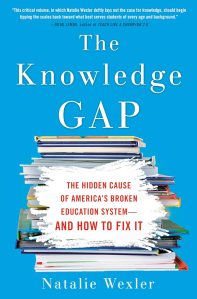
The Knowledge Gap: The Hidden Cause of America’s Broken Education System — and How to Fix It
by Natalie Wexler
I have been seeing a steady flow of articles about the stunted literacy among high school graduates and college students.* Wexler’s excellent reportage indirectly points to a root cause: flawed reading pedagogy in elementary school. In a nutshell, the book explains the dire consequences of the shift from phonics-based reading instruction to “whole language” (aka “balanced literacy”) methods which focus on reading “skills” independent of content.
Aside from this prevailing method being unsupported by cognitive science—and never mind that the whole point of reading is to comprehend meaning—it creates a compounding problem in other subjects like science, history, and civics because students acquire knowledge and understanding by building on existing knowledge. So, if the seeds aren’t planted in elementary school, high school teachers have no foundation to build upon.
Chapter 11 makes me wonder if the mind-boggling surge in learning disability diagnoses* may be explained, in part, by the trend toward ineffective reading instruction, that is to say reading inabilities rather than cognitive disabilities.
PROFICIENCY. “Despite many hours of practice and an enormous expenditure of resources, American students’ reading abilities have shown little improvement over more than twenty years, with about two-thirds of students consistently scoring below the ‘proficient’ level. Most fourth-graders aren’t actually ready to progress from ‘learning to read’ to ‘reading to learn.’ Writing scores are even worse: about three-quarters of eighth- and twelfth- graders score below proficient.”
“The stagnation in reading scores isn’t the only distressing feature of the education landscape: many American students lack basic knowledge about the world. On the most recent nationwide test of eighth-graders, only 18% scored proficient or above in US history, as did only 23% in civics and 27% in geography—the lowest scores on national tests in any core subject areas. Even students at well-regarded colleges can display a weak grasp of history and government.”
“Students who aren’t reading on grade level by third grade are four times less likely to graduate from high school.”
DECODING AND COMPREHENSION. “Educators have generally lumped together the two basic components of reading—decoding and comprehension—and treated them as one ‘subject.’ But cognitive scientists have found that the factors leading to such success in each are fundamentally different.”
“Decoding refers to the process of translating alphabetic symbols into words, and there’s an overwhelming scientific consensus that the best way to teach decoding is to teach fundamental reading skills in a systematic and explicit manner—often referred to, somewhat inaccurately, under the umbrella term phonics. First, children need to learn to distinguish the sounds in spoken language and in individual words, a process called phonemic awareness. Then they need to learn how those sounds correspond to letters (strictly speaking, that’s phonics). They also need to practice to the point where they can read fluently, with the appropriate speed and intonation. If all children were taught phonics this way, as many as 95% would become proficient decoders. This includes most children who are diagnosed as dyslexic, along with most ‘garden variety’ struggling readers, many of whom are from low-income families.”
“As for comprehension, the most important factor in determining whether readers can understand a text is how much relevant vocabulary or background knowledge they have… Comprehension, unlike decoding, doesn’t occur as a result of teaching students a set of skills they have to practice repeatedly. It’s something people achieve more or less naturally—if they have enough information.”
“Professors of education, on the other hand, have come to exactly the opposite conclusions. For many years, the majority of American educators shared the fundamentalist belief that decoding was the part of reading that occurs naturally, without much skills-focused instruction.” The author is critical of the pseudoscience taught in colleges of education.
COGNITIVE PSYCHOLOGY. “When we try to make sense of what we read, we rely on what cognitive scientists refer to as working memory, something [psychology professor Daniel] Willingham called the staging ground for thought… It’s the process whereby we take in new information and combine it with the facts and procedures stored in our long-term memory. The key thing about working memory is that it has a limited capacity. And information in working memory is lost if it isn’t quickly ‘rehearsed’—perhaps articulated or written about.”
“So time is of the essence when trying to assimilate new information. If we can relate it to something we already know, it speeds up the process considerably. If we need to stop and look up every other word, or puzzle them out from context, we’re far less likely to be able to understand and retain what we’re reading.”
“Scientists also use the word schema to describe this process. A schema is a mental framework constructed from accumulated information and experience and stored in long-term memory. When people already have a schema for a topic, new information on that topic has something it can stick to.”
“Readers begin to find a text difficult to understand when a mere 2% of the vocabulary is unfamiliar.”
READING WARS: PHONICS VS WHOLE LANGUAGE. “The theory that has shaped the American approach to elementary education goes like this: Reading—a term used to encompass not just matching letters to sounds but also comprehension—is a set of skills that can be taught completely disconnected from content.”
“And the argument goes, through the third grade, children need to spend their time ‘learning to read’ before they can progress to ‘reading to learn.’ Social studies and science can wait: history is too abstract for their young minds and should wait. In the early years, the focus must be on the reading skills that will equip students to acquire knowledge about the world—later.”
“A decade after Why Johnny Can’t Read [published in 1955], the Dick and Jane method began evolving into a related philosophy called ‘whole language,’ and a few decades later it morphed into ‘balanced literacy’—a label that most reading teachers in the United States would probably use to describe their approach today, although they don’t always agree on what it means… In the 1980s and 1990s… the whole-language approach took over classrooms at a breathtaking pace.”
“Meanwhile, the evidence continued to mount that instruction in phonics was the most effective way of teaching reading. By the mid-1990s, one researcher observed that it was ‘one of the most well-established conclusions in all of behavioral science… Children who can’t decode are unlikely to ever become avid readers.”
“It’s possible, though, that by pushing students to constantly be aware of their schema, teachers were unintentionally making reading more frustrating—turning ‘relatively simple and intuitively obvious tasks into introspective nightmares,’ as David Pearson had once worried… Metacognition can be one more thing a reader’s overloading working memory has to juggle.”
“In a unit on the American Revolution for fourth graders, for example, the lessons aren’t actually about any events or figures of the era. Instead, their titles are phrases like ‘The Role of Emblematic Detail in Nonfiction,’ or ‘Readers Study All Parts of a Text to Determine Main Ideas.’ The idea is that some other topic could easily be substituted.”
“There’s no evidence at all behind most of those ‘skills’ teachers spend time on… The focus should be on the content of the text.”
KNOWLEDGE. “What if it turns out that the best way to boost reading comprehension is not to focus on comprehension skills at all but to teach kids, as early as possible, the history and science we’ve been putting off until it’s too late? A handful of schools across the country have been experimenting with that approach—which, in the context of American education, represents a radical break with the status quo—with sometimes astonishing results.”
“The widespread belief among educators that history and non-hands-on science are inappropriate for young children isn’t just at odds with what many parents sense intuitively. It’s also not supported by the evidence. A few educational approaches, like the century-old Montessori movement, have long been introducing children to these subjects with great success.”
“The fact is, history is a series of stories. And kids love stories. The same is true for science topics that don’t lend themselves to hands-on activities. It’s ironic that truly abstract concepts like captions and symbols are considered appropriate for six-year-olds, but informational tales about history, science, and the arts are not.”
“The implication is clear: abstract ‘reading ability’ is largely a mirage constructed by reading tests. A student’s ability to comprehend a text will vary depending on his familiarity with the subject; no degree of ‘skill’ will help if he lacks the knowledge to understand it. While instruction in the early grades has focused on ‘learning to read’ rather than ‘reading to learn,’ educators have overlooked the fact that part of ‘learning to read’ is acquiring knowledge.”
“Education certainly shouldn’t end with facts. But if it doesn’t begin there, many students will never acquire the knowledge and analytical abilities they need to thrive both in school and in life.”
“The more knowledge a child starts with, the more likely she is to acquire more knowledge. She’ll read more and understand and retain information better, because knowledge… sticks best to other related knowledge.”
“The ability to think critically—like the ability to understand what you read—can’t be taught directly and in the abstract. It’s inextricably linked to how much knowledge you have about the situation at hand.”
At an elementary school in Baltimore, “a new principal, Thom Stroschein, introduced a curriculum based on [E.D. Hirsch’s] Core Knowledge Sequence.” Test scores soared. “But eventually, Stroschein left for another job, and the next principal replaced Core Knowledge with a basal program she used before. Scores fell to their previous levels.”
“Ideally, schools will adopt a curriculum that builds that general knowledge in a logical sequence from year to year, balancing familiar and fresh content so that students are challenged but no overwhelmed, and revisiting concepts periodically to reinforce learning.”
HIGH SCHOOL. “For teachers at upper grade levels… students often arrive with huge gaps in their knowledge.”
“An understanding of civics fundamentally depends on an understanding of history. It’s hard to grasp how the system operates if you have no idea where it came from and no context in which to place it. And students who have had little or no exposure to history in elementary and middle school struggle to absorb and retain historical concepts when they encounter them for the first time in high school. Adults who lack basic knowledge about American government likely took a civics course in high school; the information just didn’t stick.”
Teachers have said their students often lack a sense of chronology. “Students may confuse the Civil War and the civil rights movement. They may think Frederick Douglas and Martin Luther King Jr. were contemporaries. In a world history class studying the segregation faced by black soldiers returning to the United States after World War I, some students were under the impression that slavery still existed in 1918… Others told me their students don’t understand the difference between a country and a continent, or between a city and a state.”
“Many students proudly enroll in college—the surest route to success—only to discover they’re so ill-prepared they need to take remedial reading and math.”
LEARNING DIABILITIES. Judith Hochman “was the curriculum coordinator at the Windward School, an independent school for students with language-based learning disabilities in a New York City suburb. The focus of Winward was on reading—and more specifically on decoding” [i.e. phonics]. When a group of high school teachers visited Windward, “they were amazed to see writing samples from learning-disabled sixth- and seventh-graders that were clearer and better organized than the writing some of their seniors were able to produce.”
WRITING. Hochman “discovered that writing, reading comprehension, and analytical ability were all connected—and that writing was the key to unlocking the other two. If you wanted to enable students to understand what they were reading, convert information into long-lasting knowledge, and learn to think critically, teaching them to write was about the best thing you could do.”
“If students have absorbed the right information, writing about it forces them to retrieve it in a way that lodges it in their long-term memories, where it can be drawn on in the future. Cognitive scientists call this retrieval practice. Writing also provides the kinds of benefits referred to as the protégé effect: when people try to teach material to others, or simply plan to, their own understanding gets a powerful boost.”
“When students write in response to a well-crafted prompt, they have no choice but to analyze how facts are related, which ones are truly important, and how best to communicate them to an unknown reader. In short, teaching writing is not only inseparable from teaching content, it can also be tantamount to teaching students how to think critically.”
However, “simply writing, and possibly making the same mistakes over and over, isn’t likely to help struggling students. Teachers need to break down the components of the process into manageable chunks and guide students through practicing those chunks in a logical sequence while providing prompt feedback. Psychologists have called this approach deliberate practice, and it’s crucial to developing mastery and expertise.”
“Beyond all that, teachers will need to ignore the Common Core’s implication that success should be measured in quantity rather than quality. And if writing instruction is to begin in elementary school, as it should, the elementary curriculum will need a hefty injection of content.”
PHILANTHROPY. “When [Bill] Gates mentioned grade levels, he spoke only of middle and high schools. And when the Foundation identified the subjects it would focus on, the list included only English, math, and science—no history or social studies… [omitting] subjects that lay the groundwork for an informed citizenry.”
PROFESSIONAL DEVELOPMENT. “American school systems spend as much as $18 billion a year on PD, which can translate into $15,000 to $20,000 per teacher. The problem with PD is that it hasn’t worked. Teachers often see it as a waste of time, and studies back that up.” Perhaps the problem is not a lack of funding, but unproductive spending.
OBESESSION WITH TESTING. “When students are under pressure to raise test scores, administrators and teachers maximize the time spent on reading and math. And yet, those efforts have been no more effective with students at the lowest end of the score spectrum than with the student population as a whole.”
“School districts want to see quick, quantifiable progress. ‘Building knowledge takes years,’ Schmidt says. ‘It’ll be three, four, five years before we start to see the payoff of teaching Core Knowledge in Washoe, in fourth- or fifth-grade test scores.’”
“Alternatively, states can follow Louisiana’s lead and continue to give ‘reading tests,’ but ensure they draw on knowledge students have acquired in school—and not just in English class.”
“In countries that perform well on international tests, like Singapore and Finland, teacher preparation is based in detailed, content-focused curricula, and new teachers aren’t expected to develop lessons from scratch.”
Wexler, Natalie. The Knowledge Gap: The Hidden Cause of America’s Broken Education System — and How to Fix It., Avery, an imprint of Penguin Random House LLC, 2020. Buy from Amazon.com
Disclosure: As an Amazon Associate I earn from qualifying purchases.
Related Books:
- The Teach Like a Champion Guide to the Science of Reading: Translating Research to Reignite Joy and Meaning in the Classroom by Doug Lemov, Colleen Driggs, and Erica Woolway (2025)
- Beyond the Science of Reading: Connecting Literacy Instruction to the Science of Learning by Natalie Wexler (2025)
- The Writing Revolution 2.0: A Guide to Advancing Thinking Through Writing in All Subjects and Grades by Judith C. Hochman and Natalie Wexler (2024)
- How Learning Happens: Seminal Works in Educational Psychology and What They Mean in Practice, second edition by Paul A. Kirschner and Carl Hendrick (2024)
- Agency: The Four-Point Plan (F.R.E.E.) for All Children to Overcome the Victimhood Narrative and Discover Their Pathway to Power by Ian V. Rowe (2022)
- Teach Like a Champion 3.0: 63 Techniques that Put Students on the Path to College by Doug Lemov (2021)
- How to Educate a Citizen: The Power of Shared Knowledge to Unify a Nation by E. D. Hirsch Jr. (2021)
- Why Knowledge Matters: Rescuing Our Children from Failed Educational Theories by E. D. Hirsch Jr. (2016)
- Trivium 21c: Preparing Young People for the Future with Lessons from the Past by Martin Robinson (2013)
- Books to Build On: A Grade-by-Grade Resource Guide for Parents and Teachers (Core Knowledge Series) by E. D. Hirsch Jr., John Holdren (1996)
- Why Johnny Can’t Read: And What You Can Do about It by Rudolf Flesch (originally published in 1955)
*Related Articles:
- Sarat, Austin, “College professors face an emerging challenge: We know students are no longer reading entire books.” The Conversation, 23 July 2026.
- Horowitch, Rose. “The End of Reading is Here.” The Atlantic. 8 July 2026.
- Leith, Sam, “We’re all doomed if English literature students can’t read books.” The Spectator, 6 October 2025.
- Wolf, Maryanne, “Skim reading is the new normal. The effect on society is profound.” The Guardian, 25 August 2018.
- Jitomirskaya, Svetlana et al, “Why the University of California should bring back the SAT/ACT now.” EdSource, 21 July 2026.
- Merhbi , Ammar A. “The Empty Review Dilemma: Why is Education Addicted to Unproven Pedagogies.” Substack, 18 June 2026.
- Wexler, Natalie, “Lower Academic Standards Can Perpetuate Unfairness.” Minding the Gap, 22 September 2026.
- Goldstein, Sam. “An epidemic of need: The surge in childhood psychiatric diagnoses.” Psychology Today, 22 April 2025.
- Fore, Preston. “40% of Stanford undergrads receive disability accommodations—but it’s become a college-wide phenomenon as Gen Z try to succeed in the current climate.” Fortune, 21 February 2026.
- Wu, Titus, “Disability scandal erupts at UCLA’s law school—as ex-student reveals shocking tactics to game system.” California Post, 25 June 2026.
- Levinovitz, Alan, “Are Colleges Getting Disability Accommodations All Wrong?” The Chronicle of Higher Education, 25 September 2024.
- Johnson, Kirk A., “Time to Refocus Special Education on Reading Achievement.” Mackinac Center for Public Policy, 3 February 2003.
Psychology Professor Daniel Willingham on teaching reading
Discover more from The Key Point
Subscribe to get the latest posts sent to your email.


