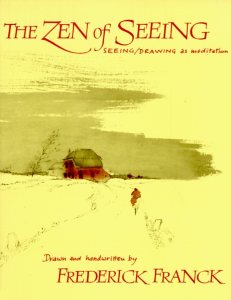
The Zen of Seeing: Seeing/Drawing as Meditation
by Frederick Franck (1909-2006)
In our time of overstimulation and shrinking attention span, Franck’s message is even more relevant now than when the book was published in 1973: “We do a lot of looking: we look through lenses, telescopes, television tubes… Our looking is perfected every day—but we see less and less. Never has it been more urgent to speak of SEEING.”
“Drawing is the discipline by which I constantly rediscover the world. I have learned that what I have not drawn I have never really seen, and that when I start drawing an ordinary thing I realize how extraordinary it is, sheer miracle: the branching of a tree, the structure of a dandelion’s seed puff.”
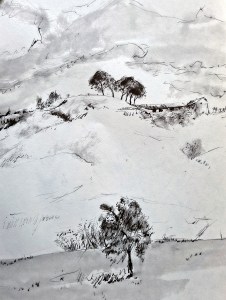
ZEN vs. EGO. “The Zen experience is the overcoming the hallucination that the Me is the valid center of observation in the universe.”
“Me-expression, which we misnomer ‘self-expression’ … is that ‘personal style’ that assumes it is more important than letting that which is seen express itself through the hand that draws… unconfused by concepts, opinions, labels, and prejudices.”
“Such a drawing is ‘personal’ in the sense one’s fingerprint is inevitably personal. It is ‘original’ in the way the ancient Chinese used this word: it is ‘in harmony with the origins.’”
“Emerson deflates the pseudo-originality the ego strains for: ‘What you are speaks so loudly I don’t hear what you say.’”
BEYOND WORDS. “Authentic, personal experience is both aim and method of Zen… The words in which the experience is later expressed are only the by-products of this absolutely personal, first hand, inexpressible experience… Where there is revelation, explanation becomes superfluous. Curiosity dissolves in wonder.”
UNLEARNING. “SEEING/DRAWING is the art of un-learning about things.”
“Everyone thinks he knows what a lettuce looks like. But start to draw one and you realize the anomaly of having lived with the lettuces all your life but never having seen one, never having seen the semi-translucent leaves curling in their own lettuce way, never having noticed what makes a lettuce a lettuce rather than a curly kale.”
“SEEING/DRAWING… is the discipline through which I extricate myself from the habitual, the mechanical, the predigested and acquisitive automatisms of our society. I stand face to face with a hill, a bird, a human face—with myself, in unwavering attention.”
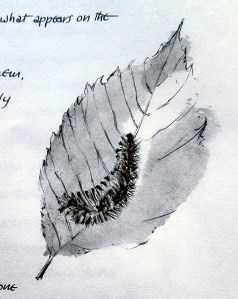
THE ART OF LEAVING OUT. “The eye that follows the sweep of earth intuitively selects hillocks and clumps of trees that define the space; it picks up and leaves out forms, details. Drawing here becomes the art of leaving out.”
ANXIETY. “At the beginning of a drawing session I am more often than not in a state of acute agitation, even panic. The first few drawings I do of a model are often nervous scribbles, for the eye cannot focus yet, the hand doesn’t obey… The Me, the ego, is straining too hard… The eye is shifty, it does not see—it looks. The brain meddles with every stroke… I learned: Just give the eye a little time to overcome its panic, to calm down until the hand dares trust it again.”
“The hostile, touchy, idiosyncratic Me has calmed down. Something in the model at last begins to speak to me: the sadness of her glance, a birthmark perhaps. I SEE again! The eye no longer jerks in half-sleep. Anxieties, memories, daydreams cease.”
LIFE DRAWING. “Every week, for at least one long session, I draw ‘from the nude.’ … This nakedness I draw constantly because its challenges are infinite, and its study takes much longer than a lifetime. The fact is, it is never merely a naked body I am drawing, but a human being I am confronted with.”
“All textbooks on drawing from life counsel not to concentrate on the face, but to look for the large forms and masses and how they relate to one another, to look for structure and for movement. This is very sound advice, but however hard I try, I just can’t help starting with at least an indication of that particular human face that belongs to that body and gives meaning to it: It is this human being I have to come to terms with, or, more precisely, I have to ‘become,’ to identify with.”
“Everyone seems to know what constitutes ‘a beautiful body,’ a ‘good body.’ But, of course, a beautiful body is not one with a set of prescribed ideal circumferences. The models I love to draw are neither necessarily young, nor well-proportioned. Pretty little things, smooth pin-ups and fashion models, with all the right measurements, taking charming poses, may bore me to distraction. Looking for the human being in this smooth posturing flesh, I find nothing but pretentious impersonal signalings: ‘Am I not lovely!’”
“Older models, exhausted from the bearing of children, the scrubbing of floors, have been inexhaustible sources of inspiration to me.”
“This nude I am drawing is not just a body, not an abstract symbol of youth or old age. She is the concrete person before my eyes: this person. It is enough. To draw her is to let the perception on my retina be affirmed by the hand that notes down in obedience. It is not in any way ‘self-expression.’ It is letting the person I draw express what she is, through me.”
“In the human being, in the human body, it is the spirit that informs the movement of every muscle.”
INTANGIBLES. “I believe that in SEEING/DRAWING there is a way of awakening the ‘Third Eye’ … where the split between the seer and what is seen is obliterated.”
I assume Franck is talking about capturing the energy or spirit of the subject. According to the Cleveland Clinic, “The pineal gland was commonly called the ‘third eye’ for many reasons, including its location deep in the center of the brain and its connection to light via the circadian rhythm and melatonin secretion. Many spiritual traditions believe it serves as a connection between the physical and spiritual worlds.”
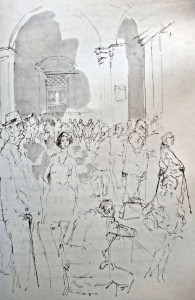
MOTION. “How to draw a crowd? It seems impossible to draw this chaos in which every single element, every single individual, moves constantly… The hand moves and keeps moving, jumping as in a dance; lines without stopping move from figure to figure. As one of the apparitions (real enough to himself!) moves out of the field of vision, his afterimage sometimes persists on the retina, so that he has not really vanished yet and can be completed in absentia. But more often heads are mated promiscuously with bodies already gone. One woman’s arm becomes another’s.”
PAINTING. “Painting, for me at least, had always strengthened, exalted the ego, the Me. Drawing—especially with the merciless pen—constantly shakes it to bits… Look at the drawings of the masters: so often, they are more direct, more authentic, than their ‘finished’ paintings, closer to Zen.”
PHOTOGRAPHY. “Nor could I combine photography with drawing. Drawing required a different kind of seeing. Pressing the button is, of course, incomparably better than waking through the world with dead eyes, but how easily it becomes a substitute for seeing, remains stuck in ‘looking!’ For my purpose, the shutter clicks much too fast. I have found that in order to SEE I must allow my eye to rest on a commonplace thing—a face, a stone, a weed (of course, the category ‘weed’ was invented by the ME, and a dandelion is in no way inferior to an orchid!)—in order to experience it with all my senses, with nerve endings bare.”
“While SEEING/DRAWING I glimpse into Nature, I taste Nature, the Nature of Reality. THE WAY OF SEEING IS A WAY OF KNOWING.”
“And yet, I know artists whose medium is Life itself, and who express the inexpressible without brush, pencil, chisel, or guitar. They neither paint nor dance. Their medium is Being…They SEE and don’t have to draw. They are the artists of being alive.”
Franck, Frederick. The Zen of Seeing. Vintage Books, 1973. Buy from Amazon.com
Disclosure: As an Amazon Associate I earn from qualifying purchases.
Related Reading:
- Stick Figures: Drawing as a Human Practice by D.B. Dowd (2018)
- Seeing It: Photography and Commentary by by Mark Hopkins (2023)
Discover more from The Key Point
Subscribe to get the latest posts sent to your email.

 The Key Point