Nine Lies About Work: A Freethinking Leader’s Guide to the Real World by Marcus Buckingham and Ashley Goodall
Conventional management practices are based on a mindset of conformity and control. The authors, in contrast, argue the key to optimum performance is encouraging individuals make the most of their idiosyncratic strengths. The authors study team performance and employee engagement for ADP Research Institute and Cisco respectively.
The Progress Principle: Using Small Wins to Ignite Joy, Engagement, and Creativity at Work by Teresa Amabile and Steven Kramer
“Inner work life influences people’s performance on four dimensions: creativity, productivity, work commitment, and collegiality… Inner work life matters for companies because, no matter how brilliant a company’s strategy might be, the strategy’s execution depends on great performance by people inside the organization.”
“To a great extent, inner work life rises and falls with progress and setbacks in the work. This is the progress principle and, although it may be most obvious on the best and worst days at work, it operates every day.”
The Progress Principle is the result of primary research by two psychologists who studied 238 knowledge workers from 26 teams in 7 companies representing 3 industries over the course of a team project—generally about 4 months. Participants submitted daily diary forms to the researchers confidentially. The authors cite some positive and negative scenarios, using pseudonyms to disguise the individuals and their employers.
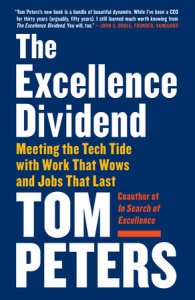
Nearly 40 years after the publication of the über-bestseller In Search of Excellence, Tom Peters has written his 19th book. His insights on organizational effectiveness (and dysfunction) are as relevant as ever.
“In In Search of Excellence, we defined Excellence in terms of long-term performance. But that begs a/the question. How do you achieve that long-term super-effectiveness? … Excellence is not an ‘aspiration.’ Excellence is not a ‘hill to climb.’ Excellence is the next five minutes.”
Given that Peters has two engineering degrees, an MBA, and a PhD in business, you might be surprised by his findings. “Enterprise excellence is about just two things: People. Service. Excellence = Service. Service to one’s teammates, service to one’s customers and vendors, service to our communities.”
The Excellence Dividend: Meeting the Tech Tide with Work That Wows and Jobs That Last by Tom Peters
Tom Peters makes a renewed call to excellence in the context of an increasingly data-driven and dehumanized world. His “putting people first” mantra is even more on point than it was when his seminal work In Search of Excellence was published in 1982.
“The primary defenses against AI-driven job destruction are widespread, relatively unconstrained creativity and novel organizational arrangements designed to produce products and services that will stand out in an automated world. I unequivocally believe that such creativity is antithetical to algorithmic optimization of human affairs.”
“So what is this Excellence Dividend? In short, businesses that are committed to excellence in every aspect of their internal and external dealings are likely to be survivors. They are better and more spirited places to work. Their employees are engaged and growing and preparing for tomorrow. Their customers are happier and inclined to spread tales of their excellence far and wide. Their communities welcome them as good neighbors. Their vendors welcome them as reliable partners. That in turn translates directly into bottom-line results and growth. And, AI and robotics notwithstanding, it translates into jobs that last and the likely creation of new jobs as well.”
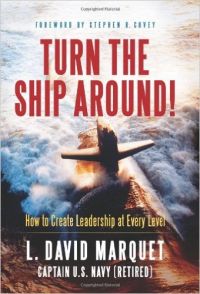
Turn the Ship Around: How to Create Leadership at Every Level by L. David Marquet , Captain, U.S. Navy (Retired)
Capt. Marquet writes about implementing a profoundly different management approach when he took command of the worst performing submarine in the U.S. Navy. “Within a year, the situation was totally turned around. We went from worst to first in most measures of performance, including the one I valued the most—our ability to retain our sailors and officers.”
“Disengaged, dissatisfied, uncommitted employees erode an organization’s [productivity] while breaking the spirits of their colleagues.” Marquet found the root cause of the problem to be the leader-follower structure, in which subordinates “have limited decision-making authority and little incentive to give the utmost of their intellect, energy, and passion… We had 135 men on board and only 5 of them fully engaged their capacity to observe, analyze, and problem solve.”
Flow is “a deep sense of enjoyment.” To be fully engaged in a state of flow, one must be skilled and challenged. “Basically, the more a person feels skilled, the more her moods will improve; while the more challenges that are present, the more her attention will become focused and concentrated.”
The premise of this book is that people are happiest and most productive when their work is well suited to their strengths. Conversely, many people pursue the “path of most resistance.” The book includes a code to access an online assessment which will identify your top five strengths.
“Gallup has surveyed more than 10 million people worldwide on the topic of employee engagement… People who do have the opportunity to focus on their strengths every day are six times as likely to be engaged in their jobs and more than three times as likely to report having an excellent quality of life in general.”
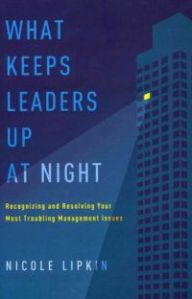
What Keeps Leaders Up at Night: Recognizing and Resolving Your Most Troubling Management Issues by Nicole Lipkin
In this excellent book, clinical psychologist Nicole Lipkin explains the psychology behind many of the human behaviors that affect productivity and sound decision making in the workplace. “Good leadership requires dealing effectively with messy, quirky, unpredictable, confusing, irrational, and clumsy people. That is what makes the business of leadership so insanely difficult and complex.”