Art: Modern, Postmodern, and Beyond
by Stephen R. C. Hicks and Michael Newberry
This brief selection of essays presents an overview of postmodernism and a plea to move on.
Hicks writes, “Why did cynicism and ugliness come to be the game you had to play to make it in the world of art?”
“The flipside of this question is: Why did representational art become a non-player? Why was it dismissed by the high-art establishment and driven underground for much of the 20th century? Why did the cutting-edge decide to abandon representation—especially representations of the positive, the healthy, the romantic, or the optimistic?”
“Until the end of the 19th century, art was a vehicle of sensuousness, meaning, and passion. Its goals were significance, originality, beauty, and the sublime. The artist was a skilled master of his craft. Such masters were able to create original representations with human significance and universal appeal. Combining vision and skill, artists were exalted beings capable of creating objects that in turn had an awesome power to exalt the senses, the intellects, and the passions of those who experience them.”
Modernism. To put postmodernism in context, Hicks first takes us through the modernist movement.
“By the beginning of the 20th century, the 19th century intellectual world’s sense of disquiet had become a full-blown anxiety. The artists responded, exploring in their works the implications of a world in which reason, dignity, optimism, and beauty seemed to have disappeared.”
“The innovation of the early modernists was to assert that form must match content. Art should not use the traditional realistic forms of perspective and color because those forms presuppose an orderly, integrated, and knowable reality.”
“The second and parallel development within modernism is Reductionism. If we are uncomfortable with the idea that art or any discipline can tell us the truth about external, objective reality, then we will retreat from any sort of content and focus solely on art’s uniqueness. And if we are concerned with what is unique in art, then each artistic medium is different.”
“For example, what distinguishes painting from literature? Literature tells stories—so painting should not pretend to be literature; instead, it should focus on its own uniqueness. The truth about painting is that it is a two-dimensional surface with paint on it. So instead of telling stories, the reductionist movement in painting asserts, to find the truth of painting, painters must deliberately eliminate whatever can be eliminated from painting and see what survives. Then we will know the essence of painting.”
“What else can be eliminated?”
“If traditionally, skill in painting is a matter of representing a three-dimensional world on a two-dimensional surface, then to be true to painting we must eliminate the pretense of a third dimension… But traditional paints have a texture, often leading to a three-dimensional effect if one looks closely. So, as Morris Louis demonstrates in Alpha-Phi (1961), we can get closer to painting’s two-dimensional essence by thinning down the paints so that there is no texture. We are now as two-dimensional as possible.”
“In Kasimir Malevich’s near-monochrome White on White, color differentiation was abandoned.”
Then came conceptual art. “Here the perceptual appeal is minimal and art becomes purely conceptual enterprise—we have eliminated painting altogether.”
“This inevitably leads us back to Marcel Duchamp, the grand-daddy of modernism who saw the end of the road decades earlier. With his Fountain (1917), Duchamp made the quintessential statement about the history and future of art… With his urinal, Duchamp offered presciently a summary statement. The artist is not a great creator—Duchamp went shopping at a plumbing store. The artwork is not a special object—it was mass-produced in a factory. The experience of art is not exciting and ennobling—it is puzzling and leaves one with a sense of distaste. But over and above that, Duchamp did not select just any ready-made object to display. He could have selected a sink or a doorknob. In selecting the urinal, his message was clear: Art is something you piss on.”
“But there is a still deeper point that Duchamp’s urinal teaches us about the trajectory of modernism… The point of the objects was not aesthetic experience; rather the works are symbols representing a stage in the evolution of philosophical experiment. In most cases, the discussions about the works are much more interesting than the works themselves.”
“Modernism had no answer to Duchamp’s challenge, and by the 1960s it found it had reached a dead end. To the extent modern art had content, its pessimism led it to the conclusion that nothing was worth saying. To the extent that it played the reductive elimination game, it found that nothing uniquely artistic survived elimination. Art become nothing.”
“Postmodernism introduced four variations on modernism.”
- “As with philosophical postmodernism, artistic postmodernism rejected any form of realism and become anti-realist… According to postmodernism, ‘reality’ and ‘nature’ are social constructs… So we may have content in our art as long as we talk self-referentially about the social world of art.”
- “One postmodern strategy has been to mix styles eclectically in order to undercut the idea of stylistic integrity.”
- “Postmodernism rejects a universal human nature and substitutes the claim that we are all constructed into competing groups by our racial, economic, ethnic, and sexual circumstances. Applied to art, this postmodern claim implies that there are no artists, only hyphenated artists: black-artists, woman-artists, gay-artists, poor-Hispanic-artists, and so on… There is the long-standing rule in [postmodern] art that one should never say anything kind about capitalism.”
- “The fourth and final postmodern variation on modernism is a more ruthless nihilism… How can we eliminate more thoroughly any positivity in art? As relentlessly negative as modern art has been, what has not been done?”
“In the 1960s Piero Manzoni canned, labeled, exhibited, and sold 90 tins of his own excrement… Andres Serrano generated controversy in the 1980s with his Piss Christ, a crucifix submerged in a jar of the artist’s urine.”
“It is time to move on… The point is not to return to the 1800s or to turn art into the making of pretty postcards. The point is about being a human being who looks at the world afresh. In each generation there are only a few who do that at the highest level. That is always the challenge of art and its highest calling.”
Authentic Art. Newberry writes, “Art is made up of four key areas: knowledge, reality, psychology, and passion. Between them they hold the keys to why art is the technology of the soul… In other words, an astute artist knows how to think, see, understand, and feel.”
“It is a marvelous thing that the character of art pulls these elements out of the artist. A blank canvas, and later, an ongoing artwork, is a type of interrogator. It broadly asks the artist: What do you know so far? What is your connection to perceivable reality? Are you being truthful or insightful about human character? Are you passionate about it?”
“For the last century, postmodern artists have fought against this magnificent phenomenon, leaving us with the sorry spectacle of mindlessness, hatred, psychosis, and apathy.”
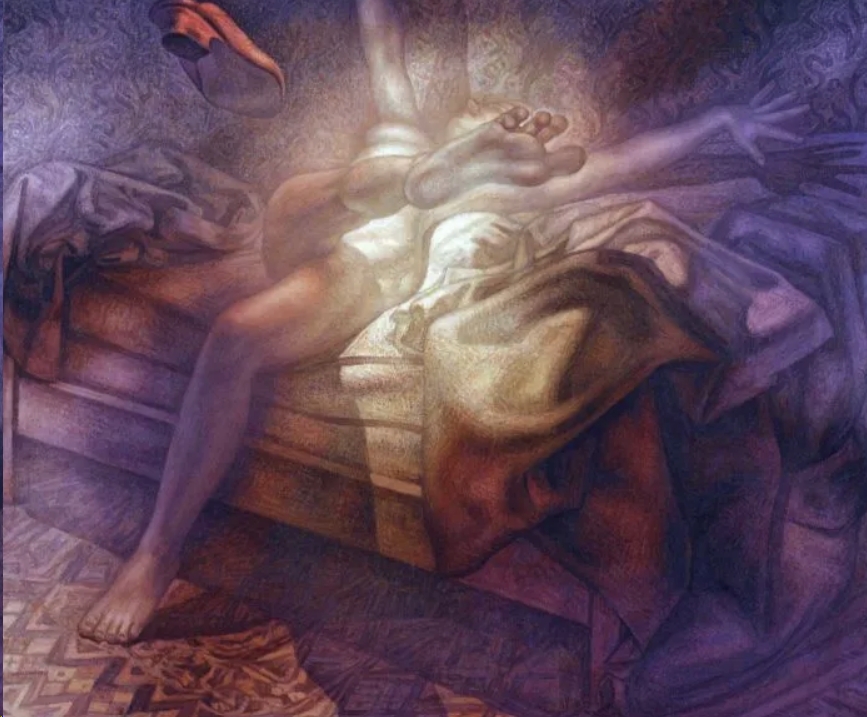
“The alternative to postmodern art is simply authentic art, which is grounded in the way humans approach life: with their minds, senses, emotional intelligence, and passions. This means going back to the future with figurative and representational art, finding new and exciting ways, creative themes, and a deep love for the amazing experience of being human.”
Newberry’s The Slipper is a dynamic painting that seems perfectly suited to illustrate this text about “kicking off” a new era in art—pun definitely intended.
Hicks, Stephen R. C., and Michael Newberry. Art: Modern, Postmodern, and Beyond. 2021. Buy from Amazon.com
Disclosure: As an Amazon Associate I earn from qualifying purchases.
Related Reading:
- Art in the Age of Emergence by Michael J. Pearce (2015)
- The Truth About Art: Reclaiming Quality by Patrick Doorly (2013)
- What Art Is by Arthur C. Danto (2013)
- The Way of Beauty: Five Meditations for Spiritual Transformation by François Cheng (2006)
- The Painted Word by Tom Wolfe (1975)
Books by Stphen R. C. Hicks:
- Liberalism: Pro & Con (2020)
- Explaining Postmodernism: Skepticism and Socialism from Rousseau to Foucault (2019)
- Ayn Rand and Business Ethics (2019)
- Nietzsche and the Nazis (2010)
Books by Michael Newberry:
- An Art Memoir: Depth and Light: Volume One 1965–2002 (2026)
- A Pastel Odyssey: Chasing Color and Light in the Aegean (2026)
- The Art Studio Companion: A Master Class for Artists (2024)
- Pandora’s Box and Other Essays: Postmortem on Postmodern Aesthetics, and the Spirit of Eudaemonia That Will Replace It (2022)
- Newberry Color Theory (2021)
- Evolution Through Art (2021)
Discover more from The Key Point
Subscribe to get the latest posts sent to your email.


