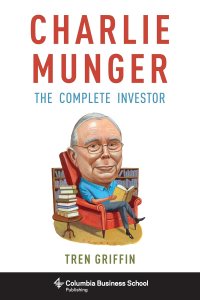
Charlie Munger: The Complete Investor
by Tren Griffin
Charlie Munger (1924-2023) was vice chairman of Berkshire Hathaway for 46 years, working closely with Warren Buffett. This book is about their approach to investing, sprinkled with quotes from Munger, Buffett, and others.
Benjamin Graham (1894-1976) was Buffett’s professor at Columbia University. The book begins with the four principles of the Graham Value Investing System.
“First Principle: Treat a share of a stock as a proportional ownership of a business… Put simply: if you do not understand the actual business of the company, you cannot understand the value of assets related to that business, like a share of stock or a bond.”
“‘You really have to understand the company and its competitive positions… That’s not disclosed by the math.’ – Charlie Munger, Berkshire annual meeting, 2013”
“‘People calculate too much and think too little.’ – Charlie Munger, Berkshire Annual Meeting, 2002”
“What Munger looks for is a business that has a significant track record of generating high, sustained, and consistent financial returns. If valuing the business requires understanding how cash flows will change in the future based on factors like rapid technological change, Munger puts that business in the too hard pile and moves on to value other companies. Munger makes it quite clear that he does not have a way to value all companies.”
“Buffett put it this way: ‘I have no use whatsoever for projections and forecasts. They create an illusion of apparent precision. The more meticulous they are, the more concerned you should be. We never look at projections but we care very much about, and look very deeply at, track records.”
“The best way to determine the value of a business is based on the price a private investor would pay for the entire business… A private market intrinsic valuation for a Graham value investor requires that the asset generate free cash flow.”
“Second Principle: Buy at a significant discount to intrinsic value to create a margin of safety… The Graham value investor’s job is to recognize mispriced assets when he or she sees them… Finding an investment opportunity with the right margin of safety is uncommon, so you must be patient.”
“Howard Marks pointed out that ‘active management has to be seen as the search for mistakes.’ In his view, it is in less-traded markets and so-called distressed assets where mistakes are most likely to be found.”
“Third Principle: “The Graham value investor believes Mr. Market is unpredictably bipolar in the short term; for that reason, when the market is depressed, it will sometimes sell you an asset at a bargain price. Other times, because it is euphoric, the market will pay you more than the asset is worth.”
“The time of the greatest activity for a Graham value investor is when the people who make up the market are fearful as evidenced by mispriced assets available for purchase. It is ironically because of downturns in markets that the Graham value investor finds his or her greatest source of profits.”
“Fourth Principle: Be rational, objective, and dispassionate.”
INTRINSIC VALUE
“Intrinsic value is the present value of future cash flows.”
“‘It’s the discounted value of the cash that can be taken out of a business during its remaining life. The calculation of intrinsic value, though, is not so simple. As our definition suggests, intrinsic value is an estimate rather than a precise figure, and it’s additionally an estimate that must be changed if interest rates move or forecasts of future cash flows are revised.’ – Warren Buffett, Berkshire Hathaway Owner’s Manual, 2014”
“Intrinsic value is a reference point in the final analysis for investors as they patiently watch the price of an investment gyrate up and down in price over time. In doing a valuation analysis, Graham value investors like Munger are very conservative.”
“Because the cash that can flow from a business is not an annuity and instead is based on a number of fundamental factors that are impossible to predict with certainty, determining the value of a business is an art and not a science… For this reason, it is best to think about intrinsic value as falling within a range rather than an exact figure.”
“An imprecise value is perfectly acceptable… because the Graham value investor is looking for a margin of safety that is so substantial that precise calculation is unnecessary. A good analogy is a waiter trying to decide whether a customer is above the legal drinking age. There are certain restaurant patrons who are obviously older than the legal drinking age, just as there are certain businesses with an intrinsic value that obviously provides the necessary margin of safety.”
“‘Intrinsic value is terribly important but very fuzzy. Two people looking at the same set of facts, moreover—and this would apply even to Charlie and me—will almost inevitably come up with at least slightly different intrinsic value figures.’ – Warren Buffett, Berkshire annual meeting, 2003”
“‘There are two kinds of businesses: The first earns 12%, and you can take it out at the end of the year. The second earns 12%, but all the excess cash must be reinvested—there’s never any cash. It reminds me of the guy who looks at all his equipment and says, ‘There’s all my profit.’ We hate that kind of business.’ – Charlie Munger, Berkshire annual meeting, 2003”
“When Munger and Buffett value a business, they use what they call owner’s earnings as the starting point. Owner’s earnings can be defined as: Net income + Depreciation + Depletion + Amortization – Capital expenditure – Additional working capital. Berkshire uses the owner’s earnings figure in this process to take into account capital expenditures that will be necessary to maintain the business’s return on equity.”
MARGIN OF SAFETY
“Margin of safety is a simple idea that is applied in different ways by different investors. Some investors like to have a margin of safety that is much larger than others. For example, one Graham value investor may require a 25% margin of safety, whereas another needs 40%. Of course, because the concept of intrinsic value itself is imprecise, the calculation of margin of safety is necessarily imprecise. Making things easier is the fact that Munger and Buffett like the amount of margin of safety to be so big that they need not do any math other than in their heads… Munger wants the math involved in evaluating an investment to be simple, overpoweringly clear, and positive.”
“A given company may be a quality company with an attractive business… but its business is not worth an infinite price.”
“‘Valuation is the closest thing to the law of gravity that we have in finance. It’s the primary determinant of long-term returns. However, the objective of investment (in general) is not to buy at fair value, but to purchase with a margin of safety. This reflects that any estimate of fair value is just that: an estimate, not a precise figure, so the margin of safety provides a much-needed cushion against errors and misfortunes.’ – James Montier, The Seven Immutable Laws of Investing, 2011”
CIRCLE OF COMPETENCE
“Too many investors confuse familiarity with competence… Buffett talks about that fact that knowing where the perimeter of your circle of competence may be is far more important than the size of your circle. If you are only competent in spots and stay in those spots, you can do just fine.”
“‘We’d rather deal with what we understand… If you try to succeed in what you’re worst at, you’re going to have a very lousy career.’ – Charlie Munger, Standford University Law School, 1998”
“Once, in an interview with Jason Zweig, Munger said it simply: ‘Knowing what you don’t know is more useful than being brilliant.’”
DIVERSIFY OR CONCENTRATE?
“Munger’s approach to valuing a business is influenced in part by Ben Graham and in part by Phil Fisher (1907-2004) … For Fisher, wide diversification is essentially a form of closet indexing. He instead believed that an investor should focus on a relatively small number of stocks if he or she expects to outperform a market. Fisher preferred a holding period of almost forever; for example, he bought Motorola in 1955 and held it until 2004… Unlike many other investors, Fisher assigned significant weight to the quality of the underlying business.”
“Seth Klarman pointed out that it is better to know a lot about ten or fifteen companies than to know just a little about many.”
“Buffett believes that diversification is protection against not knowing what you’re doing—and when it comes to investing, nearly no one knows what they are doing. The most diversified approach is to buy a portfolio of low-fee index funds and exchange-traded funds.”
“‘The wise ones bet heavily when the world offers them that opportunity. They bet big when they have the odds. And the rest of the time, they don’t. It’s just that simple.’ – Charlie Munger, USC Business School, 1994”
“When in doubt, his suggestion is that you do nothing.”
QUALITY OF THE BUSINESS
“Buffett once said, ‘More than 50 years ago, Charlie told me that it was far better to buy a wonderful business at a fair price than to buy a fair business at a wonderful price.’”
“‘Leaving the question of price aside, the best business to own is one that, over an extended period, can employ large amounts of incremental capital at very high rates of return. The worst business to own is one that must, or will, do the opposite—that is, consistently employ ever-greater amounts of capital at very low rates of return.’ – Warren Buffett, 1992 Berkshire Shareholder Letter, 1993”
“Whether a business has a durable moat is without question the most important attribute for an investor like Munger… If there’s no significant barrier to entry that creates a sustainable competitive advantage, inevitable competition will cause the return on investment for that business to drop to opportunity cost and there will be no economic profit for the producer.”
“‘We buy barriers. Building them is tough… Our great brands aren’t anything we’ve created. We’ve bought them… One competitor is enough to ruin a business running on small margins.’ – Charlie Munger, Berkshire annual meeting, 2012”
“‘The difference between a good business and a bad business is that good businesses throw up one easy decision after another. The bad businesses throw up painful decisions time after time.’ – Charlie Munger, Berkshire annual meeting, 1997”
“Munger and Buffett are not interested in investing in company ‘turnarounds,’ because they seldom actually do turn around. Munger wants the moat of the company he is investing in to be strong enough to survive bad management.”
GROWTH
“Return on invested capital (ROIC) is the ratio of after-tax operating profit divided by the amount of capital invested in the business. In short, how much a business earns on the capital employed in its business determines the quality of that business for Munger and Buffett. Growth of the business is, by itself, neither good nor bad.”
“‘Growth is always a component in the calculation of value, constituting a variable whose importance can range from negligible to enormous and whose impact can be negative as well as positive… Growth benefits investors… only when each dollar used to finance the growth creates over a dollar of long-term market value. In the case of a low-return business requiring incremental funds, growth hurts the investor.’ – Warren Buffett, 1992 Berkshire shareholder letter, 1993”
“‘Growth benefits investors only when… each dollar used to finance the growth creates over a dollar of long-term market value.’ – Warren Buffett, 1992 Berkshire Shareholder Letter, 1993”
CAPITAL ALLOCATION
“The primary activity at Berkshire is capital allocation.”
“‘Proper allocation of capital is an investor’s number one job.’ – Charlie Munger, Poor Charlie’s Almanack, 2005”
“The most important task in capital allocation for Buffett and Munger is to take cash generated by a company like See’s Candies and deploy it to the very best opportunity at Berkshire.”
“‘Charles T. Munger, Berkshire Hathaway’s vice-chairman, and I really have only two jobs… One is to attract and keep outstanding managers to run our various operations. The other is capital allocation.’ – Warren Buffett, The Essays of Warren Buffett, 2011.”
“Avoid what Buffett called the institutional imperative… ‘Just as work expands to fill available time, corporate projects or acquisitions will materialize to soak up available funds.’ – Warren Buffett, Berkshire annual meeting, 1989.”
“Munger believes that every manager of a business should be thinking about intrinsic value when making all capital allocation decisions.”
“‘In the end, plenty of unintelligent capital allocation takes place in corporate America. That’s why you hear so much about restructuring.’ – Warren Buffett, 1987 Berkshire annual letter, 1988”
MANAGEMENT
“Munger makes it clear that he has no desire to buy an otherwise ‘good’ business with lousy management and then try to find someone to run it: ‘We don’t train executives, we find them.’”
“‘Remember that reputation and integrity are your most valuable assets—and can be lost in a heartbeat.’ – Charlie Munger, Poor Charlie’s Almanack, 2005”
“‘Understanding how to be a good investor makes you a better business manager and vice versa.” – Charlie Munger, Kiplinger, 2005”
COMPENSATION
“Munger and Buffett also want managers to have what Nassim Taleb calls ‘skin in the game.’ … They want risk and benefits to be symmetrically allocated. For Munger, the presence of the right incentives for a manager is critical. Buffett added that he wants to see managers have ‘a major portion of their net worth invested in the company. We eat our own cooking.’”
“‘It isn’t enough to buy the right business. You also have to have a compensation system that’s satisfactory to the people running them.’ – Charlie Munger, Wesco annual meeting, 2005”
“The best place to see the Berkshire compensation philosophy set out is in the Berkshire Owner’s Manual.”
BUREAUCRACY
“Munger also fears bureaucracy and Berkshire works hard to prevent it from lowering returns by creating what they call a seamless web of deserved trust.”
“‘If you worked for AT&T in my day, it was a great bureaucracy… And in a bureaucracy, you think the work is done when it goes out of your in-basket into somebody else’s in-basket. But, of course, it isn’t. It’s not done until AT&T delivers what it’s supposed to deliver… The constant curse of scale is that it leads to big, dumb bureaucracy.’ – Charlie Munger, University of Southern California (USC) Business School, 1994.”
RISK
“Risk is the possibility of suffering a loss—not price volatility… [Money managers] love equating risk with volatility because it gives investors the impression that risk can be precisely quantified, which helps justify their fees. Risk cannot be fully expressed as a number.”
“‘Using a stock’s volatility as a measure of risk is nuts. Risk to us is 1) the risk of permanent loss of capital, or 2) the risk of inadequate return. Some great businesses have very volatile returns—for example, See’s Candies usually loses money in two quarters of each year—and some terrible businesses can have steady results.’ – Charlie Munger, Berkshire annual meeting, 1997”
“The higher the price you pay for an asset, the greater the risk that you will experience a loss of capital. If the price of a stock drops, risk goes down, not up. For this reason, the Graham value investor will often find that price decrease for a given stock is an opportunity to buy more of that stock.”
“Munger and Buffett’s approach to risk: ‘[Subtract] (the probability of loss times the amount of possible loss) from (the probability of gain times the amount of possible gain). That is what we’re trying to do. It’s imperfect, but that’s what it’s all about. – Warren Buffett, Berkshire Annual Meeting, 1989”
“In Buffett’s 1993 Berkshire shareholder’s letter, he pointed out that risk comes from not knowing what you’re doing.”
Munger “will only invest if he strongly believes the current earnings are nearly certain to continue. While most other investors will adjust the discount rate for what they may believe to be greater risk, Berkshire wants essentially no risk as a starting point… However, to provide a cushion against mistakes, they will not actually buy an asset without at least a 25% discount in intrinsic value. (This discount is their margin of safety).”
BERKSHIRE MATH
“In making an intrinsic value calculation, Berkshire uses the long term (30-year) U.S. Treasury rate as the discount rate… What is happening in this process is an examination of opportunity cost.”
“Buffett has said, ‘Charlie and I don’t know our cost of capital… We measure everything against our alternatives… We use the risk-free rate to equate one item to another… We can always buy government bonds. Therefore, that becomes the yardstick rate… to simply compare all kinds of investment opportunities across the spectrum.’”
“First, Berkshire calculates the past and current ‘owner’s earnings’ of the business. Then they insert into the formula a reasonable and conservative growth rate of the owner’s earnings. They solve for the present value of the owner’s earnings by discounting using the 30-year U.S. Treasury rate. The focus of the investing process at Berkshire is on return on equity (ROE), not earnings per share (EPS).’
“In determining intrinsic value, Munger doesn’t swallow the stories of promoters who sing songs and tell tall tales about EBITDA (earnings before interest, taxes, depreciation, and amortization) and non-GAAP (generally accepted accounting principles) ‘earnings.’ He likes genuine free cash flow.”
Griffin, Tren. Charlie Munger: The Complete Investor. Columbia Business School Publishing, 2017. Buy from Amazon.com
Disclosure: As an Amazon Associate I earn from qualifying purchases.
“I would say that the chief advantage Berkshire has had in accumulating a good record is that we have avoided the pompous bureaucratic systems. We’ve tried to give power to very talented people and let them make very quick decisions.”
“Every time you hear EBITDA, just substitute it with bullshit earnings.”
Related reading:
- The Warren Buffett Way by Robert Hagstrom (30th anniversary edition, 2024)
- The Essays of Warren Buffett: Lessons for Corporate America by Lawrence A. Cunningham (2023)
- Margin of Trust: The Berkshire Business Model by Lawrence Cunningham and Stephanie Cuba (2020)
- Skin in the Game by Nassim Taleb (2020)
- Berkshire Beyond Buffett: The Enduring Value of Values by Lawrence A. Cunningham (2014)
- Investing: The Last Liberal Art by Robert Hagstrom (2013)
- The Investor’s Manifesto: Preparing for Prosperity, Armageddon, and Everything in Between by William J. Bernstein (2012)
- The Most Important Thing by Howard Marks (2011)
- The Little Book that Beats the Market by Joel Greenblatt (2010)
- The Little Book of Behavioral Investing: How not to be your own worst enemy by James Montier (2010)
- Value Investing: Tools and Techniques for Intelligent Investment by James Montier (2009)
- The Snowball: Warren Buffett and the Business of Life by Alice Schroeder (2009)
- Seeking Wisdom: From Darwin to Munger, 3rd Edition by Peter Bevelin (2007)
- Warren Buffett Speaks: Wit and Wisdom from the World’s Greatest Investor by Janet Lowe (2007)
- Poor Charlie’s Almanack: The Essential Wit and Wisdom of Charles T. Munger, edited by Peter D. Kaufman (originally published in 2005)
- Damn Right! Behind the Scenes with Berkshire Hathaway Billionaire Charlie Munger by Janet Lowe (2000)
- Influence: The Psychology of Persuasion by Robert Cialdini (1998)
- Margin of Safety: Risk-Averse Value Investing Strategies for the Thoughtful Investor by Seth A. Klarman (1991)
- Common Stocks and Uncommon Profits by Philip Fisher (originally published in 1958)
- The Intelligent Investor: The Definitive Book on Value Investing by Benjamin Graham, with commentary by Jason Zweig (2006, originally published in 1949)
- The General Theory of Employment, Interest, and Money by John Maynard Keynes (originally published in 1936)
Books Recommended by Charlie Munger:
- In the Plex: How Google Thinks, Works, and Shapes Our Lives by Steven Levy (2021)
- Master of the Game: How Steve Ross Rode the Light Fantastic from Undertaker to Creator of the Largest Media Conglomerate in the World by Connie Bruck (2020)
- The Selfish Gene: 40th Anniversary Edition by Richard Dawkins (2016)
- Judgment in Managerial Decision Making by Max H. Bazerman and Don A. Moore (2012)
- Yes!: 50 Scientifically Proven Ways to Be Persuasive by Noah J. Goldstein Ph.D., Steve J. Martin, Robert Cialdini (2009)
- Deep Simplicity: Chaos, Complexity, and the Emergence of Life by John Gribbin (2005)
- Titan: The Life of John D. Rockefeller, Sr. by Ron Chernow (2004)
- The Warren Buffett Portfolio: Mastering the Power of the Focus Investment Strategy by Robert G. Hagstrom (2000)
- The Wealth and Poverty of Nations: Why Some Are So Rich and Some So Poor by David S. Landes (1999)
- Models of My Life by Herbert A. Simon (1996)
- Benjamin Franklin by Carl Van Doren (1938)
Also by Tren Griffin:
- A Dozen Lessons for Entrepreneurs by Tren Griffin (2017)
- The Global Negotiator: Building Strong Business Relationships Anywhere in the World by Trenholme J. Griffin and W. Russell Daggatt (1991)
Discover more from The Key Point
Subscribe to get the latest posts sent to your email.


