
The ACME Catalog
by Charles Carney. Illustrations by Scott Grass
As seen on TV! ACME has been the preferred vendor of your favorite Looney Tunes characters for over 60 years.
Continue reading “The ACME Catalog”
The ACME Catalog
by Charles Carney. Illustrations by Scott Grass
As seen on TV! ACME has been the preferred vendor of your favorite Looney Tunes characters for over 60 years.
Continue reading “The ACME Catalog”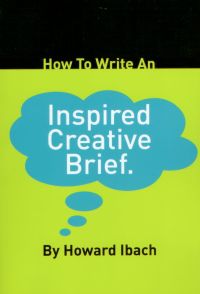
How to Write an Inspired Creative Brief
by Howard Ibach
In an advertising agency, a creative brief is a set of instructions for the creative team, providing a clear understanding of the communication objectives and expected deliverables. “If you get the brief wrong, the creative work you see at the end of the process, when your team presents it, will also be wrong.” Garbage in, garbage out.
Continue reading “How to Write an Inspired Creative Brief”
The Quick and Easy Guide to Mind Map
by Thomas C. Randall
This book introduces the topic of mind mapping. A mind map is a diagram used to visually communicate the relationships between ideas. The mind map starts with a keyword or short phrase. Lines are drawn out to sub-ideas, then to sub-sub-ideas if applicable.
The book explains several uses for mind maps, such as:
Continue reading “The Quick and Easy Guide to Mind Map”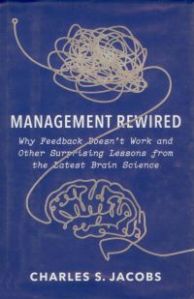
Management Rewired: Why feedback doesn’t work and other surprising lessons from the latest brain science
by Charles S. Jacobs
This book is applies neuroscience research to the field of management.
The trend in business has been toward making data-driven decisions, but Charles Jacobs explains why using only the logical side of our brain would lead to myopic decisions. Fortunately, the prefrontal cortex is connected to the amygdala, the portion of the brain which deals with emotion and memory, and this helps us make judgments based on previous experience. This reminded me of what Jack Welch has written about managing from the gut, which Welch says is basically pattern recognition.
Continue reading “Management Rewired”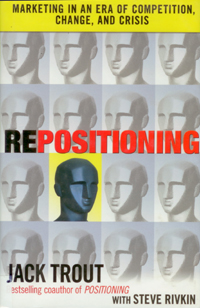
Repositioning: Marketing in an Era of Competition, Change, and Crisis
by Jack Trout with Steve Rivkin
Repositioning by Jack Trout (1935-2017) is a follow-up to a book called Positioning: The Battle for Your Mind, which Trout co-wrote with Al Ries 30 years prior.
Positioning is a competitive strategy, which Trout defines as “how you differentiate yourself in the mind of your prospect.” Repositioning is about adjusting perceptions about you or about your competition. Trout stresses simplicity–you need one powerful differentiating idea, the more obvious the better.
Continue reading “Repositioning: Marketing in an Era of Competition, Change, and Crisis”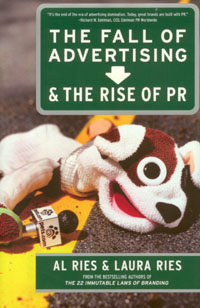
The Fall of Advertising and The Rise of PR
by Al Ries and Laura Ries
The Fall of Advertising and The Rise of PR is about the role of PR versus the role of advertising in brand marketing. The thesis is that PR is needed to launch a brand and establish its identity; advertising is for maintaining an existing brand’s position. The reason is that advertising has no credibility, so it can only remind people of what they already believe.
Continue reading “The Fall of Advertising and the Rise of PR”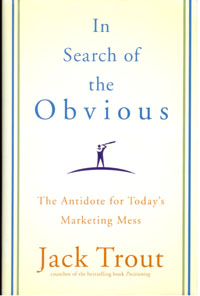
In Search of the Obvious: The Antidote for Today’s Marketing Mess
by Jack Trout
Jack Trout (1935-2017) had been a marketing professional for over 40 years. This book is about how the marketing profession has gotten off course, and the importance of timeless fundamentals, simplicity, and common sense.
Trout is critical of Madison Avenue. “To me it’s creativity run amok…The fact is that creativity was always a misnomer. An agency isn’t creating something. The company or product or service already exists. What they are doing is figuring out what is the best way to sell it. That, simply stated, means to take that logical, differentiating argument and dramatize it.”
Continue reading “In Search of the Obvious”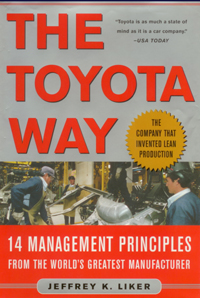
The Toyota Way
by Jeffrey Liker
The Toyota Way provides an excellent introduction of the Toyota Production System and insights into the company culture.
Toyota is the leader of lean production. In contrast to batch and queue systems, lean focuses on one-piece flow. The customer is the next process and the ideal batch size is one, so the source of defects can be discovered before thousands of defective parts are made.
Continue reading “The Toyota Way”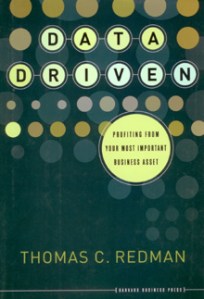
Data Driven: Profiting from your most important business asset
by Thomas C. Redman
Written for business managers, this book is about managing data as an asset. As with any asset, data only create value when used, as opposed to merely being stored. Data can support internal processes and decisions or it can be sold to external customers.
Continue reading “Data Driven”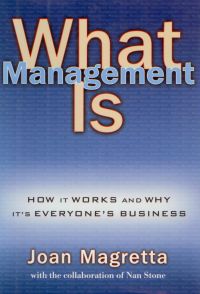
What Management Is: How it works and why it’s everyone’s business
by Joan Magretta
The author says this book is about the basics of management, but she adds, “the basics aren’t always obvious.” Topics include: value creation, business models, competitive strategy, organization, numbers, innovation, and managing people.
Continue reading “What Management Is” The Key Point