Reinventing You: Define Your Brand, Imagine Your Future by Dorie Clark
This book is about making a career change. It starts with understanding your transferable skills, identifying how you are different as a competitive advantage, then establishing a narrative to make sense of your transition.
Robert Adams, a photographer of the American West for over 50 years, writes about the art of photography. Before commenting on the works of 27 photographers, he shares his views on art in general, and he examines the work of his favorite painter, Edward Hopper.
“It is the responsibility of artists to pay attention to the world, pleasant or otherwise, and to help us live respectfully in it. Artists do this by keeping their curiosity and moral sense alive, and by sharing with us their gift for metaphor. Often this means finding similarities between observable fact and inner experience.”
The Non-Designer’s Guide to Design Thinking: What a Marketer Learned in Design School by Kunitake Saso
“The design thinking process is not a collection of steps… [It] is characterized by switching between four different modes as needed, and advancing work through short cycles… You go back and forth between the phases again and again, slowly raising the quality of your output; therefore, it is better to think of it as a compass than as a map.”
The Four Modes of Design Thinking:
Research
Analysis
Synthesis
Prototyping
The author says that 80% of the value is created in the synthesis and prototyping stages.
RESEARCH. The subjects of design research interviews are often “extreme users with strong preferences, or experts in the field and very familiar with the trends” rather than average users.
Stick Figures: Drawing as a Human Practice by D.B. Dowd (interview)
D.B. Dowd, professor of art and American culture studies at Washington University and faculty director of the D.B. Dowd Modern Graphic History Library, writes that drawing is above all else a tool for learning. This beautifully printed book covers drawing as a means of discovery and communication, confusion between visual modes, a nostalgic look at the field of illustration, and musings about the teaching of art.
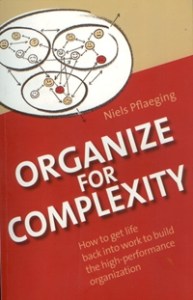
Organize for Complexity: How to get life back into work to build the high-performance organization by Niels Pflaeging
“As we have seen, the world has already changed—high complexity in value creation has become the norm.” This book proposes a cell-based organizational structure (Beta) better suited to a complex, unpredictable world than the traditional hierarchical system (Alpha).
This is the story of how a simple pencil is manufactured using numerous raw materials from all over the world, as told in the first person by the pencil itself. It was first published in 1958 to explain how free-market economies work and to discredit centrally-planned economies, such as the Soviet Union. While trade barriers are not expressly discussed in the story, the reader can infer potential consequences rippling through the supply chain.
The Soft Edge: Where Great Companies Create Lasting Success by Rich Karlgaard
It is noteworthy that a prominent business journalist from Silicon Valley—where technology and IPOs dominate headlines—wrote a book about the human factors of business success. “The yin and yang of effective management has always been about the search for the right spot between data truth and human truth.”
“Hard-edge execution is all about managing exactly to the numbers. The people who live on the hard edge of business are good at making the trains run on time. They focus on profit. Their language is time, money, and numbers. Every company in the world needs these employees.”
“Soft-edge excellence—in trust, smarts, teams, taste, and story—tends to attract loyal customers and committed employees.” Karlgaard says the soft edge is “the heart and soul” of your company.
One Year Wiser: 365 Illustrated Meditations by Mike Medaglia
This book provides an illustrated thought to ponder for each day of the year. Each page features words of wisdom from a writer, poet, scientist, spiritual leader, or other historical figure. Pages are labeled January 1 through December 31, without a year so the book can be referred to indefinitely. Below are some sample quotes and illustrations.
“And the day came when the risk to remain tight in a bud was more painful than the risk it took to blossom.” – Anaïs Nin
“Reality is like a face reflected in the blade of a knife; its properties depend on the angle from which we view it.” – Master Hsing Yun
Restaurant & Bar Marketing: The No Bullshit Guide to Improving Guest Counts by Erik Shellenberger
Erik Shellenberger cuts through the hype and tells you what really works—and what doesn’t—to bring more customers into restaurants and bars. Before getting into the tactics, he presents his ocean versus fishbowl concept.
The fishbowl includes people who follow you on social media, who subscribe to your email list, etc. “The ocean—NOT the fishbowl—is where you improve guest counts… People who have no idea you exist. People who are looking to branch out and try new places to eat and drink in their home city… The tourist economy is almost exclusively an ocean environment. It includes the person using Google or online reviews to find a business like yours.”
The Responsible Company: What We’ve Learned from Patagonia’s First 40 Years by Yvon Chouinard and Vincent Stanley
We hear a lot about sustainability, but the authors contend “no human economic activity is yet sustainable… Responsible seems to us the apt, more modest, word to use… The term itself is necessary shorthand; there is no responsible company, only responsible companies of varying degrees, who act strategically to do less harm while improving, not sacrificing, the health of the business.”
Doing good and seeking profit are not incompatible. Wal-Mart’s initial environmental efforts were motivated by reputation management, “but removing excess packaging from deodorant sticks, concentrating laundry detergent in small bottles, and installing auxiliary power units in their trucks to reduce idling time turned out to save them millions of dollars.”